Biodegradable Cleaning Products That Really Work
Biodegradable cleaning products often clean better than traditional detergents on everyday grease, soap scum and lingering odors while leaving fewer toxic residues that can harm people or the environment. This article explains how modern enzymes, probiotics and plant-based surfactants break down grime, when biodegradable cleaners are the better choice, and the dilution and dwell-time rules that deliver professional results. For managers and homeowners alike, those benefits mean a safer workplace or home, fewer refill trips and easier progress toward zero-waste goals.
Key takeaways
- How they work: enzymes digest organic soils, probiotics reduce re-soiling and plant surfactants lift oils so grease and odors rinse away without toxic residues.
- Check certifications: look for EPA Safer Choice, EU Ecolabel, OECD 301 references and on-pack test data rather than vague “natural” claims.
- Use correctly: follow dilution ratios, allow recommended dwell time and agitate or reapply on stubborn soap scum for professional results.
- Know limits: biodegradable cleaners suit routine, bond and post-construction cleaning; use hospital-grade disinfectants for infection-control and sterilization.
- Choose refill options: tablets, powders or concentrated pouches cut cost and waste; trial samples and auto-restock simplify implementation.
Why biodegradable cleaning products clean
Biodegradable cleaning products use targeted biology and cleaner chemistry rather than relying on harsh chemicals. Enzymes cut organic soils into smaller, soluble fragments, probiotics colonize cleaned surfaces to discourage re-soiling, and plant-derived surfactants lift and suspend oils so they rinse away. This combination works particularly well when organic residues and recurring messes are the main problem.
These formulations often outperform harsh chemicals on kitchen grease, baked-on soap scum and stubborn odors, and they help surfaces stay fresher between deep cleans. They suit routine maintenance in offices, rental properties and homes, while high-risk sterilization still requires validated hospital-grade disinfectants. Operational benefits include fewer refill trips, lower exposure to toxic residues and simpler compliance with green procurement policies.
- Grease: concentrated plant surfactants dissolve oils with less scrubbing.
- Soap scum: enzymes break down organic films so they rinse away easily.
- Persistent odors: probiotics digest odor-causing molecules instead of masking them.
- Routine maintenance: diluted concentrates keep surfaces cleaner longer.
Follow these practical rules to get consistent results: dilute multi-surface concentrates about 1:30 (30 mL per litre) for everyday cleaning and 1:10 for heavy soils or bathroom work. For grease and soap scum, allow three to five minutes of dwell time and agitate with a brush before rinsing; enzymatic odor sprays typically need 10 to 15 minutes and should be allowed to air dry. For light maintenance, dilute 1:50 and wipe, and always follow the product label for laundry and dish formulations. Remember that infection-control or sterilization tasks require hospital-grade products with validated contact times.
These steps improve performance without adding toxic boosters. Below, learn how to read certifications, labels and Safety Data Sheets so you can choose proven biodegradable cleaning products for each task.
How to read certifications, labels and ingredient lists
Know what different certifications cover so you can interpret label claims. EPA Safer Choice evaluates individual ingredients and links to third-party biodegradability and toxicity data, often referencing OECD-style tests that measure how quickly a molecule breaks down and its aquatic toxicity. The EU Ecolabel sets biodegradability and aquatic-toxicity limits, while Ecocert focuses on natural origin, minimum biodegradability thresholds and restrictions on certain synthetics.
To confirm a product is genuinely biodegradable, read technical sheets and on-pack claims rather than relying on marketing language. Look for terms such as “readily biodegradable” or explicit references to OECD 301 or equivalent test methods; MADE SAFE and B Corp certifications are useful signals but do not replace a biodegradability test. Treat EWG ratings as hazard indicators only, since EWG does not typically verify biodegradability data.
Decoding ingredient lists and Safety Data Sheets becomes straightforward once you know which classes to watch for. Scan for surfactant types and check SDS (section 12) for biodegradability and ecotoxicity notes. For polymer-specific guidance, consult technical white papers such as the industry review on PVOH biodegradability to understand test methods and expected breakdown profiles.
- Anionic surfactants (sulfates, sulfonates): effective cleaners with variable biodegradability; check for readily biodegradable variants.
- Nonionic surfactants (alcohol ethoxylates): highly effective but verify they are rapidly biodegradable.
- Amphoteric surfactants (cocamidopropyl betaine): milder and often biodegradable.
Use this quick two-step worksheet to vet any product before purchase. First, scan the ingredient list for phosphates, nonylphenol ethoxylates or vague “fragrance” entries; if those appear, treat the product with caution. Second, open the SDS (section 12) and look for “readily biodegradable” or an OECD 301 reference; presence of those entries is a positive signal. Together, these checks give a rapid pass/fail for biodegradability claims.
With these checks in hand, you can match certified products to everyday cleaning tasks and site needs. For a look at broader market shifts and what to expect next year, see our Commercial Cleaning Trends 2025. Below are top picks for multi-surface, dish, laundry and bathroom cleaning that work well in commercial and residential settings.
Top picks: multi-surface, dish, laundry and bathroom
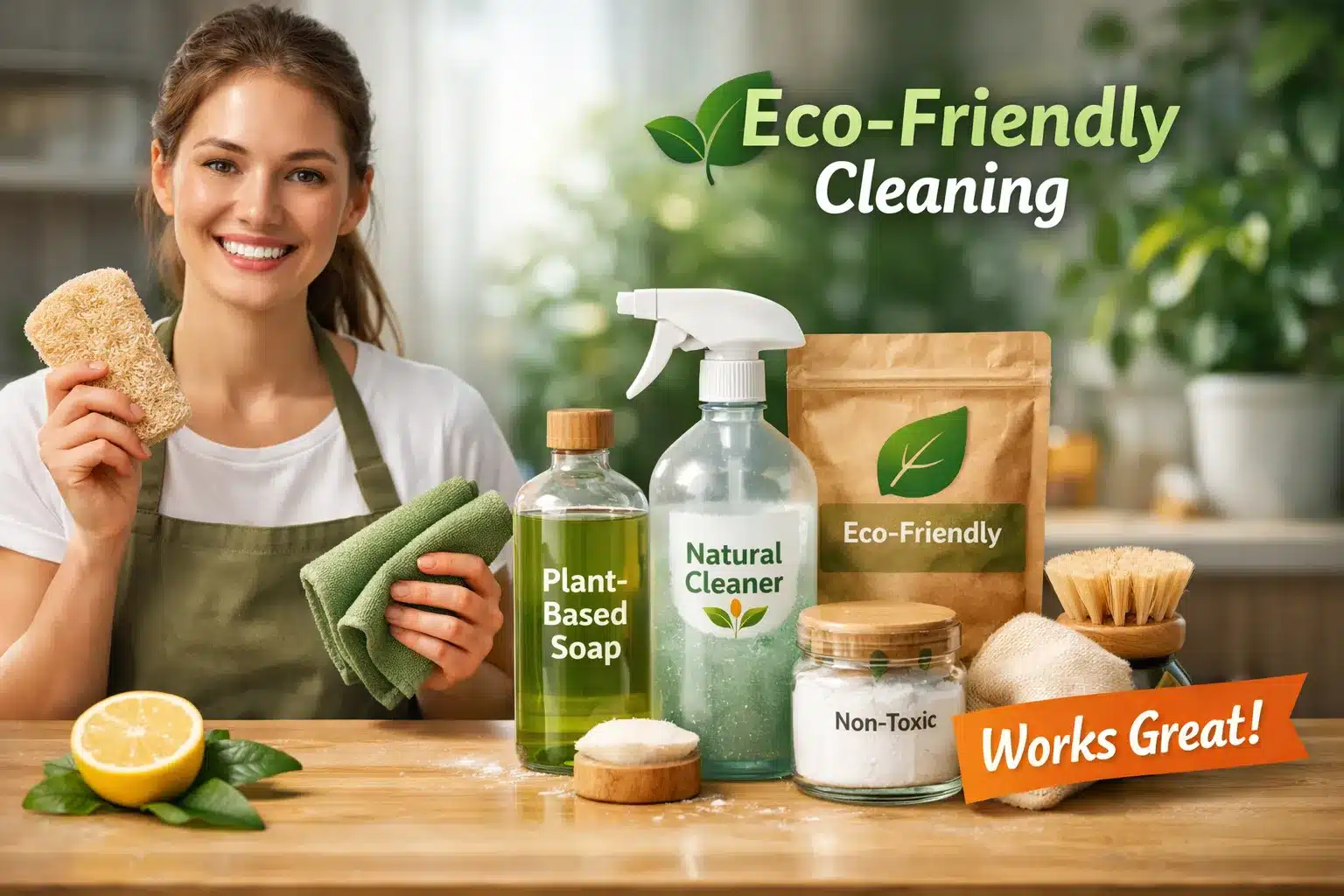
For multi-surface cleaning, consider concentrated, low-toxicity options such as Branch Basics, Dr. Bronner’s Sal Suds and Koala Eco. Branch Basics is fragrance-free and dilutes across floors, counters and some textiles, which suits scent-sensitive offices and rental properties. Dr. Bronner’s Sal Suds offers strong grease lift for heavy soils, while Koala Eco uses Australian botanicals and recycled packaging for local sourcing.
For dishwashing, zero-waste tablet systems from Blueland and Grove cut plastic waste and perform well with hot water; tablets are typically bio-based and labelled septic-safe, though a rinse aid can help prevent spotting in hard water. Typical per-wash costs vary: tablets about $0.30 to $0.60, refill concentrates $0.12 to $0.25 and mass-market liquids $0.08 to $0.20 depending on concentration and retailer. Compare uses per pack rather than price per bottle to see real cost differences.
Laundry and bathroom cleaning favour concentrated systems and enzymatic cleaners for targeted performance. Brands such as Blueland, Dirty Labs and Meliora offer refillable laundry concentrates and enzyme or probiotic bathroom cleaners that handle protein stains, slow-draining grime and persistent odors. Use enzymes for organic stains, oxygen bleach for colour-safe brightening and surfactants for everyday grease and soils.
- Homeowner on a budget: refillable concentrates and surfactant-based options.
- Scent-sensitive sites: fragrance-free Branch Basics or unscented concentrates.
- Limited refill access: zero-waste tablets or pre-measured pods for convenience.
- Property managers and offices needing infection control: keep hospital-grade disinfectants available and arrange trade purchasing. For managers equipping hybrid teams or staff working remotely, consult this guide to choosing a notebook for remote work to match devices to operational needs.
Refill, zero-waste and cost comparisons that save money
Refill options come in three practical formats: tablets or strips, powders, and concentrated pouches. Tablets and strips are light and convenient for small storage spaces, powders balance compactness and ease of dosing, and concentrated pouches offer the best economy while requiring careful measuring and more on-site storage. Because transport weight affects shipping cost and carbon footprint, lighter refills usually reduce logistics expenses for multi-site operations. For an overview of the refill movement and packaging innovations, read about the rise of refillable cleaning products and how brands are changing packaging.
Starter kits typically cost $20 to $50 for a reusable bottle and dosing cap, with refill packs ranging $5 to $20 depending on format and concentration. For example, a $10 concentrated pouch that makes 50 refills works out to about $0.20 per use, while a $15 pre-mixed refill that yields 25 uses is about $0.60 per use; amortising a $30 starter bottle across multiple refills lowers the per-use cost further. Concentration and refill frequency determine real savings, so compare uses per pack rather than sticker price alone.
Australian availability for refill and zero-waste options has improved, with local operators such as Zero Co and Koala Eco and international suppliers available through distributors or direct shipping. Many brands support subscription refills and white-label networks for businesses, enabling scheduled deliveries or co-branded bulk refills through national wholesalers and B2B partners. These options make rollouts easier for property managers and facilities teams. For practical office-focused advice and procurement tips, see our office cleaning resources.
CleansePro offers trade pricing, auto-restock tailored to your usage patterns and next-day delivery across the Gold Coast to simplify switching for business customers. Request a sample kit or set up a refill trial to verify dosing and waste savings before committing to a full rollout. Below is a checklist for spotting misleading claims when evaluating suppliers.
How to spot greenwashing: a practical checklist
Watch for label red flags such as vague “natural” claims, undisclosed “fragrance” entries and “plant-derived” statements without concentration details. Hero ingredients listed at the end of an ingredient list are a common marketing trick, so ask suppliers for full ingredient disclosure and a complete INCI panel before you buy.
Request hard documentation rather than marketing copy: OECD biodegradability test results, the SDS (section 12) biodegradability entry, and copies of certificates such as Green Seal, EU Ecolabel or ECOCERT. A short procurement email can speed the process; for example: “Please send OECD biodegradability data, the SDS (section 12) biodegradability entry, and any certification certificates for this product.”
Verify packaging claims against local recycling streams. Check resin codes and local council acceptance, confirm recycled-content percentages rather than vague “made from recycled plastic” claims, and require EN 13432 or ASTM D6400 certificates for compostability claims. If local recycling does not accept a material, plastic-free or refillable options are usually the better choice.
Use this buy/not-buy checklist when evaluating suppliers to avoid greenwashing. Require full ingredient disclosure, certification proof and verification of packaging recyclability before you purchase. Also check septic and marine safety where relevant and insist on refill or concentrate options for lower waste. The quick checklist below summarises the essentials.
- Ingredient disclosure: full list required.
- Certification proof: test reports and certificates.
- Packaging reality: local acceptance and recyclability verified.
- Septic and marine safety confirmed where relevant.
- Refill or concentrate options available.
Keep a one-page checklist handy; CleansePro Cleaning Blog provides a downloadable version to streamline procurement for multi-site operations. Below we explain how product choice pairs with practical waste handling and compliance at site level.
How CleansePro pairs biodegradable products with better waste disposal
CleansePro runs a bottle take-back program that arranges empty-container pickup with certified recycling partners to keep plastic out of landfill. Customers schedule collections through the CleansePro portal or book site pickups, and consolidated loads reduce transport emissions while simplifying waste handling for on-site teams.
CleansePro manages concentrated and regulated waste to meet local hazardous-waste rules. Segregate concentrates, store small regulated quantities in labelled bunded cabinets and prepare manifests; CleansePro supplies SDS-backed disposal instructions and labelling templates so transfers to certified collectors are compliant and audit-ready.
Rollouts follow a short implementation template so busy managers get consistent results. Key steps include selecting refill formats that match tasks, labelling dispensers with product name and dilution, training staff with a 15-minute session and a digital checklist, and scheduling regular collections using CleansePro templates and live inspection photos. These steps make refills and waste workflows simple to maintain from day one.
Pairing biodegradable cleaning products with practical waste handling delivers measurable reductions in landfill and supply costs while simplifying operations. Expect a two- to six-week setup and commissioning window depending on site size; the primary savings come from using less single-use plastic, lower shipping weight from concentrates and fewer emergency orders. Track bottles avoided per month, percentage of waste diverted and avoided stockouts to quantify wins, and contact CleansePro for trade pricing, auto-restock trials and help setting up a waste-smart refill program.