Essential SWMS for Cleaners: Download Templates
SWMS for cleaners are not a box-ticking exercise. A safe work method statement is the document that stands between your workers and a preventable injury, between your business and a failed compliance audit, and between your client relationship and a legal liability that could shut your operation down. Wet floors, chemical fumes, biological hazards, and high-risk equipment are daily realities in cleaning work. The wrong controls, or no controls at all, result in serious injuries, lost contracts, and penalties under Australian WHS legislation.
This guide covers everything you need to build a compliant cleaning SWMS: when the law requires one, which hazards to document, what a WHS-compliant format looks like, and how to download editable templates you can customise for your specific jobs. Professional cleaning teams should prepare site-specific SWMS documents before starting every high-risk job, because no two client sites carry the same risks.
When cleaners are legally required to have a SWMS
Under Australia’s Work Health and Safety Regulations, a SWMS for cleaners is mandatory when the work involves high-risk construction activity or poses a serious injury risk through the use of high-risk equipment or chemicals (see Safe Work Australia guidance on SWMS requirements for high-risk construction work). Standard cleaning tasks don’t automatically trigger the requirement, but the line is crossed more often than most contractors realise.
What counts as high-risk cleaning work
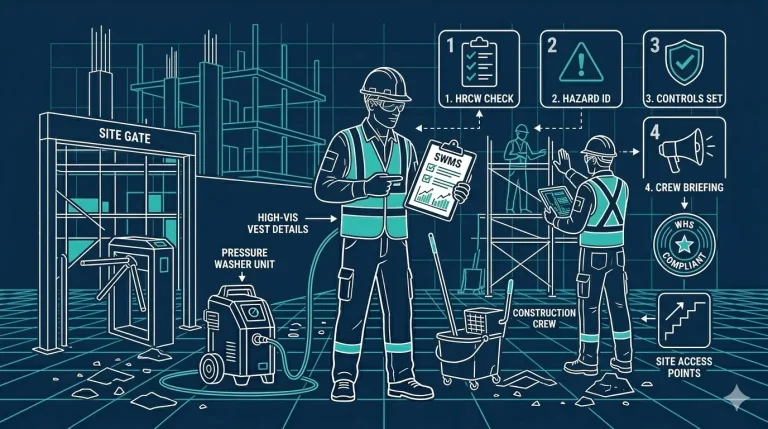
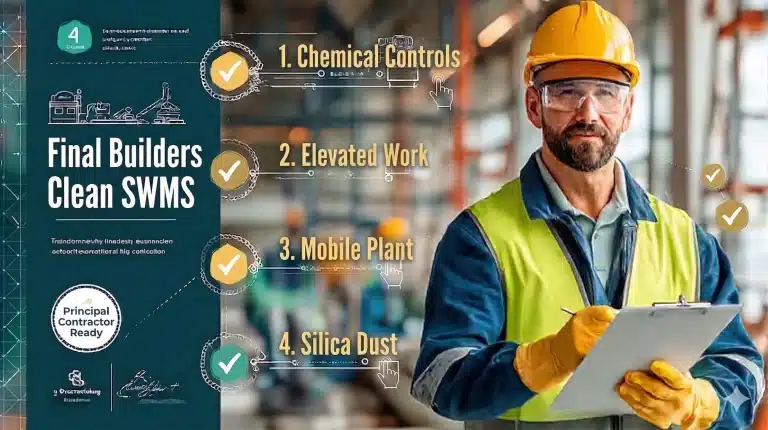
The tasks that trigger a SWMS obligation include window cleaning or high-level dusting above 2 metres, use of powered plant or equipment capable of causing serious injury, work involving hazardous chemicals, and any cleaning performed on active construction or demolition sites. For projects valued at $250,000 or more, the principal contractor must obtain the SWMS from any cleaning subcontractor before high-risk work begins, refer to the Model WHS Regulations for the specific clause governing this threshold. If your team is on a commercial fit-out doing a builder clean, this requirement applies to you. See our Final Builders Clean Checklist | Free PDF Download, CleansePro for a practical builder-clean companion document.
PCBU obligations and worker consultation
The PCBU (person conducting a business or undertaking) is responsible for preparing the SWMS before work starts. That preparation must happen in consultation with workers, safety officers, and health and safety representatives. Workers must have access to the document at all times and must be able to stop work immediately if it deviates from the SWMS. Consultation is a legal requirement, not a courtesy.
Retention and record-keeping rules
The SWMS must be accessible on-site throughout the job. If a notifiable incident occurs, the document must be retained for a minimum of two years. Note that digital copies are acceptable provided they can be retrieved promptly during an inspection. A SWMS is a live document, not a one-off form, it must be reviewable and stored in a way that allows rapid retrieval when needed.
The hazards a cleaning SWMS must identify
A cleaning SWMS that lists vague hazards will not satisfy an audit and will not protect your workers. Every document needs specific, task-level hazard identification backed by concrete control measures that follow the hierarchy of controls: eliminate, substitute, isolate, engineer, administer, then PPE as the last line of defence.
Chemical and biological risks
Chemical hazards include skin burns, respiratory irritation, eye injuries, and toxic reactions from incorrect dilution, mixing, or inadequate ventilation. Biological risks span bacteria, viruses (MRSA, COVID-19, hepatitis), fungi, and bodily fluids, particularly relevant in restrooms, kitchens, and healthcare settings. Required controls include SDS sheet compliance, correctly labelled storage, separation of incompatible chemicals, and appropriate PPE including gloves, eye protection, and respiratory protection. For hot water extraction processes, industry guidance recommends a minimum water temperature of 70°C for disinfection purposes. For a detailed overview of common cleaning hazards and best-practice controls, see Nilfisk’s article on cleaning hazards.
Slips, trips, falls and working at height
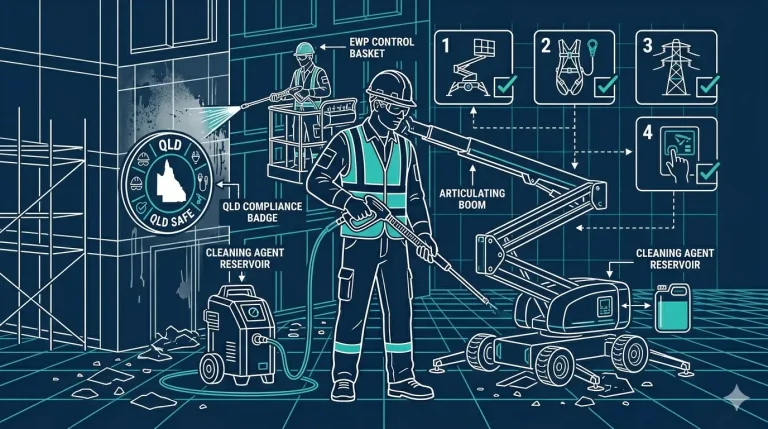
Wet floors are the most common source of cleaning injuries, and controls must be specific. Your SWMS needs to document wet floor signage, area isolation until surfaces dry, non-slip footwear requirements, cable management protocols, and the use of wet/dry vacuums to minimise residual moisture on walking surfaces. For tasks at height, the SWMS must specify stable access equipment, guardrails or fall arrest systems where applicable, and measures to prevent lone work at height where the risk is significant. Generic controls like “take care” are not acceptable in an audit.
Equipment hazards and ergonomic strain
Electrical hazards from damaged cords, wet hands near power sources, and equipment without current test-and-tag certification are common in cleaning environments. Ergonomic risks from heavy lifting, repetitive bending, and incorrect equipment handling cause significant injury across the industry. Controls must include daily pre-start equipment inspections, GFCI outlet use, procedures against pulling cords, and ergonomic tool selection for high-frequency tasks. Assign a named person responsible for each control so accountability is clear.
What a WHS-compliant cleaning SWMS must include
A cleaning SWMS template that holds up in an audit follows a consistent, structured format aligned with WHS Regulations s299, 303. Understanding the mandatory fields upfront saves you from rebuilding documents from scratch after a compliance review.
Mandatory fields and document headers for SWMS for cleaners
Every compliant SWMS must include the following fields:
- Company name, ABN, and business address
- Site address and project description
- PCBU contact details
- The date the SWMS was prepared and provided to the principal contractor
- A step-by-step task breakdown
- Identified hazards and associated risks
- Details of the persons responsible for implementing and monitoring controls
- Emergency procedures and references to relevant WHS legislation
Omitting mandatory fields risks failing a compliance review (refer to WHS Regulations s299, 303 for the full list of required content).
Building a hazard matrix that passes an audit
A hazard matrix structures risk assessment in a table format with a column for each of the following: work step, potential hazard, initial risk rating (likelihood multiplied by consequence), control measures, residual risk after controls are applied, and the responsible person. Each row corresponds to a specific task step, making it straightforward for an auditor or inspector to trace how each risk is managed. Use a consistent 1, 5 scale for both likelihood and consequence, producing a score between 1 and 25. A score above 15 requires immediate high-order controls before work proceeds.
Review logs, version control and sign-off requirements
The SWMS must capture individual worker sign-offs confirming each person has read, understood, and agrees to comply with the document. The supervisor or PCBU representative signs separately. A review log at the end of the document records any changes, the revision date, and who authorised the update. Version control fields prevent confusion on multi-day or multi-phase jobs and create a clear audit trail if your document is ever challenged.
Editable SWMS templates for cleaners: the most common task types
The right starting point is a solid editable template built for the specific type of work you’re performing. A general office cleaning template will not cover all the hazards in a carpet clean or a pressure wash job. Below are the four task categories most cleaning businesses need to document.
Commercial cleaning SWMS template
A commercial cleaning SWMS template covers the full scope of an office or facility clean: chemical use, equipment operation, floor mopping, restroom sanitation, and waste disposal. The template should include an SDS reference section, an area-by-area task breakdown, a PPE checklist, and emergency contact fields. Platforms like SafetyCulture and Sitemate’s Safe Work Method Statement (cleaning) template offer editable digital versions with electronic signature support, PDF export, and version history, check each provider’s product page to confirm current features. The WHS cleaning template structure outlined above applies directly to this format.
Carpet cleaning and pressure washer SWMS templates
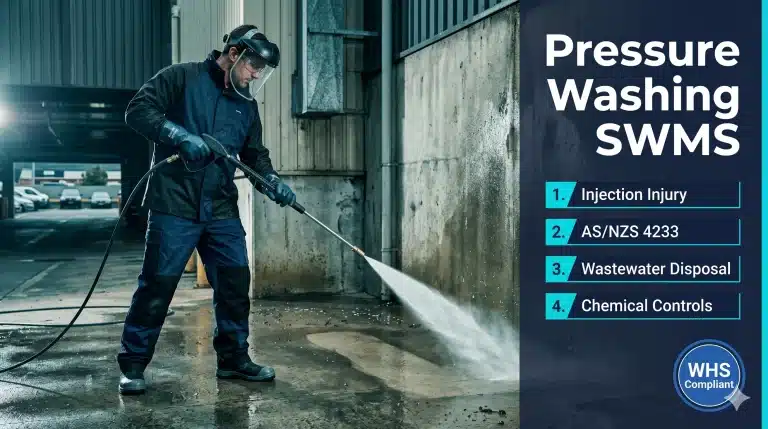
These two task types require task-specific additions to a base commercial cleaning template. A carpet cleaning SWMS must flag chemical hazards from carpet-specific solvents, wet floor slips during and after treatment, heavy equipment handling for extraction machines, and ventilation requirements in enclosed spaces. A pressure washer SWMS adds high-pressure water injection injury risks (jets above 1,500 PSI can cause serious lacerations or injection wounds), slip hazards from water runoff, noise exposure between 85 and 100 dB(A), and equipment recoil management. Start with a general template and build these task-specific hazard rows into your matrix.
Public area cleaning SWMS template
Public area cleaning introduces additional complexity: bystander safety, unpredictable foot traffic, variable environmental conditions, and often a principal contractor as an oversight authority. Dedicated templates from providers like Maxima Cleaning Group’s public areas SWMS (PDF) and BlueSafe include bystander control measures, sequential task scheduling, mandatory PPE fields, and worker compliance agreement sections with individual sign-off rows. These are detailed examples worth using as a benchmark for any client-facing job. If you’re working in a shopping centre, hospital precinct, or public facility, use one of these as your starting point.
How to complete, sign off and review your SWMS step by step
Having a template is only the starting point. Completing it correctly and keeping it current is where most cleaning businesses fall short. Here is the full process from first draft to ongoing review.
Gathering site details and consulting your team
Start by completing all header fields: company details, ABN, site address, job description, and principal contractor contact. Before writing any hazard rows, walk the site with your workers and ask what could go wrong at each step. Worker consultation is a legal requirement, not optional, and the insights regularly surface hazards that a desk-based assessment would miss. Document who was consulted, their role, and the date the consultation occurred.
Working through the hierarchy of controls
For each task step in your SWMS, list the hazard, assign an initial risk rating, then identify the highest-order control possible. Can the hazard be eliminated entirely? Substituted for a safer process or product? If not, work down the hierarchy through engineering controls, administrative controls, and finally PPE. Assign a residual risk score after controls are applied and name the person responsible for ensuring each control is in place before work starts. Every row in your hazard matrix should tell a complete story: what the risk is, what you’ve done about it, and who owns it.
Worker sign-off, supervisor approval and review triggers
Every worker who will perform the task must sign the SWMS individually, confirming they have read it, understand it, and hold the required skills or certifications for the work. The supervisor or PCBU representative signs separately. The SWMS must be reviewed immediately when tasks change, a near-miss or incident occurs, a safer method is identified, a new hazard appears on site, or a health and safety representative requests a review. Log every review in the revision table with the date, reason for review, and who authorised any changes. Annual review is a best-practice minimum even when no trigger events occur.
Why site-specific preparation matters, and how CleansePro does it
An editable SWMS download gets you started. It does not get you compliant on its own. Every site has different layouts, different chemical inventories, different access arrangements, and different risk profiles. Applying a template without site-specific adaptation is one of the most common reasons SWMS documents fail audits, and, more critically, fail to protect workers.
A template for commercial cleaning will not account for the narrow service corridors in a medical facility, the live electrical hazards on an active construction site, or the bystander risks in a shopping centre car park. The hazard matrix rows need to reflect what workers will actually encounter on that specific site, on that specific day. The sign-off fields must name actual site contacts and real emergency procedures, not placeholder text.
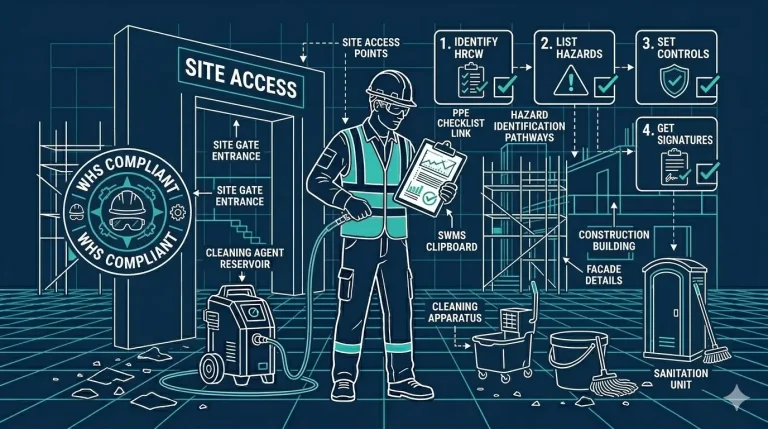
At CleansePro, site-specific preparation is built into every job as a standard practice. The approach involves assessing the actual layout, identifying chemical storage and usage requirements for that facility, documenting access points and height risks, and referencing the correct SDS sheets for the products used in that environment. Workers receive a copy of the tailored document, review it before work begins, and sign off individually. For clients, this means cleaning services, from a commercial office clean to a post-construction builder clean, come with documentation that reflects the real risks of their site, not a generic checklist.
A compliant SWMS for cleaners is the foundation of professional work
SWMS for cleaners separate compliant, professional operations from those exposed to injury, liability, and failed audits. The steps are clear: know when a SWMS is legally required, document the right hazards with the right controls, use a structured WHS-compliant format, start from a solid editable template, and complete the sign-off and review process correctly every time.
Businesses that want documentation, trained police-checked teams, and zero compliance gaps can see how CleansePro operates across every commercial, office, and residential clean. The preparation standard described in this guide is how CleansePro approaches every job. If you are starting or scaling a cleaning business, consider our How to Start a Cleaning Business in Australia + SWMS Pack for a compliance-ready startup bundle.
Download Cleaning SWMS Template Free Sample + 2025 Edition, customise it for your site, and contact CleansePro if you want cleaning services that match the preparation standard this guide describes.