What Is a SWMS? A Plain-English Guide for Cleaning Contractors
If you’ve just been asked for a SWMS before starting a job and you’re not sure what one is, you’re not alone. A lot of cleaning contractors encounter this document for the first time when a site supervisor stops them at the gate and won’t let them in without one.
This guide explains exactly what a SWMS is, when Australian law requires it, what must be inside it, who is responsible for preparing it, and how to get a proper one fast. No jargon. No filler.
What Does SWMS Stand For?
SWMS stands for Safe Work Method Statement. It’s a formal written document required under the Work Health and Safety Regulation 2011 before any high-risk construction work begins.
The document does three things:
- Identifies the specific high-risk activities involved in the task
- Lists the hazards associated with each step of the work
- Specifies exactly how each hazard will be controlled before anyone starts
It is a legal requirement: not a best-practice recommendation, not an optional extra, and not something you can approximate on the day with a verbal briefing. If the work triggers the requirement, you need a completed SWMS before the high risk work starts, and on a construction project the principal contractor must have a copy first.
When Is a SWMS Legally Required in Australia?
The requirement is triggered by High-Risk Construction Work (HRCW). Under the WHS Regulation 2011, there are defined categories of work that automatically require a SWMS. Your task only needs to fall into one of them.
For cleaning contractors, the most common triggers are:
- Fall risk over 2 metres: window cleaning from an EWP, cleaning elevated surfaces on a construction site, roof cleaning
- Confined space entry: cleaning inside tanks, enclosed plant rooms, industrial ducts, or storage voids
- Work near energised electrical services: post-construction cleans where electrical systems are live but not yet fully commissioned
- Powered mobile plant operating nearby: construction sites where forklifts, cranes, or excavators are still moving
The key point: the trigger is the working conditions, not the cleaning task itself. A crew vacuuming dust from a building at 4 metres above ground needs a SWMS, not because vacuuming is dangerous, but because the elevated working environment crosses the HRCW threshold.
Routine office cleaning, standard residential cleaning, and ground-level commercial work generally do not require a SWMS. The obligation applies when the cleaning is construction work that falls into one of the 18 high risk types, such as a fall risk over 2 metres, a confined space or moving powered mobile plant.
Cleaners working on construction sites usually need a White Card as well. See White Card QLD for cleaners.
What about Queensland specifically?
Queensland operates under the WHS Regulation 2011 (Qld), which mirrors the national framework with minor variations. For a detailed breakdown of QLD-specific requirements, fine amounts, and retention rules, read our SWMS Template QLD guide.
What Is the Difference Between a SWMS and a JSA?
This comes up constantly on construction sites and it matters to get right.
A JSA (Job Safety Analysis) is a general risk identification tool. It is used across many industries for routine or lower-risk tasks. It has no specific legal mandate under Australian WHS Regulations.
A SWMS carries direct legal weight under the WHS Regulation 2011. It applies specifically to HRCW. It has mandatory content and retention requirements, and on a construction project a copy must go to the principal contractor before the work starts.
Both documents look similar on the surface: hazards, controls, steps. But they are not interchangeable. Presenting a JSA to a WorkSafe inspector on an HRCW site will not satisfy your legal obligation. They will identify the gap immediately and work will stop.
If the work triggers HRCW, use a SWMS. Not a JSA. Not a general risk assessment. A SWMS.
What Must Be Inside a SWMS?

A SWMS that will stand up to a principal contractor review or a WorkSafe inspection should contain all of the following. Section 299 of the WHS Regulation sets out the core content, and the rest makes the document easier to follow and check.
What to include:
Task sequence: each step of the work listed in logical order from site setup to pack-down. For a builders clean, that might be: site induction → area setup → chemical handling → elevated cleaning → dust removal → site handover. Five to fifteen steps is typical.
Hazard identification: for each task step, the specific hazard must be named. Not “fall risk.” Not “chemicals.” The specific hazard: “unguarded edge at 3.5 metres during window cleaning from scissor lift” or “caustic degreaser contact risk during oven cleaning.” Vague descriptions fail audits.
Control measures: for each hazard, the controls applied must follow the hierarchy of controls in order:
- Eliminate the risk entirely where possible
- Substitute with something less hazardous
- Engineering controls: guardrails, exclusion zones, HEPA filtration, dust suppression
- Administrative controls: safe work procedures, supervision, signage, toolbox talks
- PPE (gloves, respirators, eye protection) as the last line of defence, not the first
Regulators expect to see higher-order controls considered before PPE is listed. A SWMS that defaults to “wear appropriate PPE” for every hazard will not satisfy an inspector.
Monitoring and review arrangements: how controls will be checked during the work. Pre-start inspections, daily toolbox talks, stop-work protocols if conditions change.
Administrative details:
- PCBU name, ABN, and business address
- Responsible supervisor name
- Principal contractor name and project details
- Work site address
- Date prepared
- Review date if conditions may change during the project
Worker signatures: not required by law, but good practice. Have every worker on the task sign and date it before work starts, to confirm they have read and understood it.
👉 Download a task-specific cleaning SWMS: from $9.99, instant delivery →
Pre-filled for real cleaning tasks. Editable Word file and PDF. Add your site details and it is ready for the principal contractor.
Who Prepares the SWMS: You or the Builder?
Your cleaning business prepares its own SWMS. Full stop.
Under the WHS Regulation 2011, the PCBU (Person Conducting a Business or Undertaking) is legally responsible for ensuring a proper SWMS is prepared before HRCW begins. In a cleaning context, the PCBU is the cleaning contractor: not the principal contractor, not the developer, not the builder.
The principal contractor’s role is to review your SWMS for alignment with the site’s WHS management plan and to monitor its implementation on site. They do not prepare it for you. If you arrive without a proper SWMS, they cannot legally allow your work to start. The legal duty sits with your business.
This is where a lot of cleaning contractors get caught. They assume the builder handles “all the safety paperwork.” The builder handles the site-wide WHS plan. Your scope of work (your SWMS) is yours.
SWMS vs Generic Free Templates: What’s the Real Difference?
Free SWMS templates are available online from government regulators, industry associations, and various safety websites. They are a legitimate starting point. Here’s the honest difference between a free generic template and a task-specific paid document.
| Free generic template | CleansePro task-specific SWMS | |
|---|---|---|
| Price | $0 | $9.99 to $29.99 |
| Specific to cleaning tasks | No | Yes |
| Pre-filled hazard controls | No | Yes |
| WHS laws referenced | Sometimes | Queensland WHS Act and Regulation 2011 |
| Editable in Microsoft Word | Sometimes | Yes, plus a PDF |
| Unlimited use across all jobs | Sometimes | Yes |
| Job steps and controls | You write them | Already written |
A free template requires you to identify every hazard, research every applicable control, and format it correctly, starting from a blank structure. For a cleaning contractor who has never written a SWMS before, that process typically takes hours and still produces a document that a site safety officer can pick apart.
A task-specific template pre-fills the hazards, controls, and legislation references relevant to that exact cleaning task. You add your business name, ABN, site details, and supervisor name, then you’re ready to submit.
The $29.99 difference is not the point. The point is that a rejected SWMS on the morning of a commercial job costs you the job, damages your relationship with the builder, and potentially triggers a regulatory visit. One rejection costs far more than $29.99.
Which SWMS Does Your Cleaning Business Actually Need?
The SWMS must be specific to the task. A window cleaning SWMS does not cover a confined space entry. A general cleaning SWMS does not cover EWP operation. Each high-risk task type needs its own document.
| Your cleaning task | The SWMS you need |
|---|---|
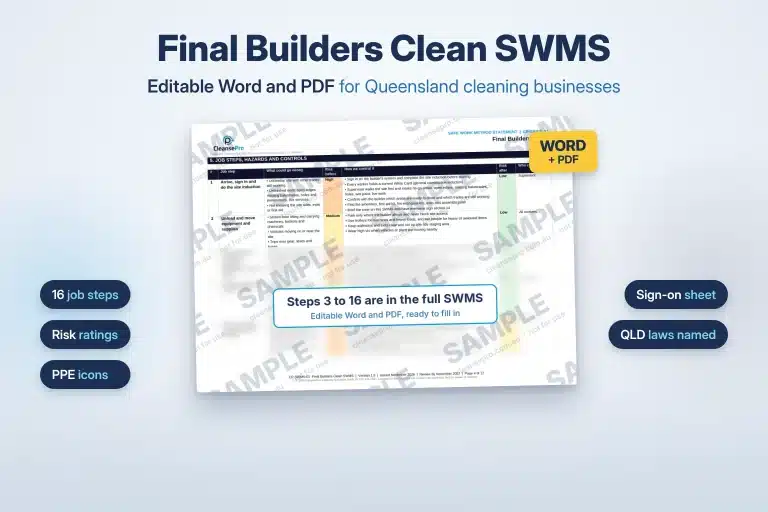
| Post-construction builders clean | Final Builders Clean SWMS: $29.99 |
| Window cleaning: water-fed pole, ladders, low-rise | Window Cleaning SWMS: $29.99 |
| Cleaning at height: ladders, mobile scaffolds, edges | Working at Heights (Cleaning) SWMS: $29.99 |
| Cleaning from a boom lift or scissor lift | EWP Cleaning SWMS: $29.99 |
| Inside multi-storey buildings: atriums, voids, balconies | High-Rise Building Cleaning SWMS: $29.99 |
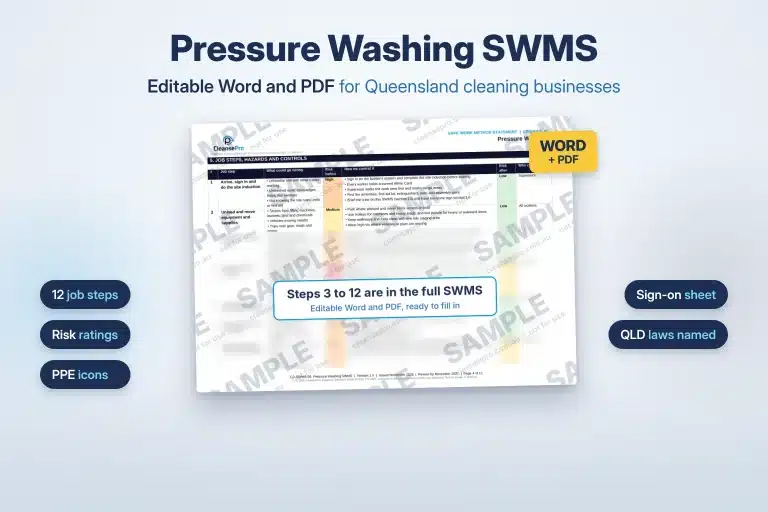
| Pressure washing | Pressure Washing SWMS: $29.99 |
| Acid washing: concrete, pavers, brick, tiles | Acid Washing SWMS: $29.99 |
| Commercial kitchen cleaning | Commercial Kitchen Cleaning SWMS: $29.99 |
| Carpet cleaning (commercial) | Carpet Cleaning SWMS: $29.99 |
| Graffiti removal | Graffiti Removal SWMS: $29.99 |
| Site toilets, lunch rooms and sheds | Porta-Loo and Site Amenities Cleaning SWMS: $29.99 |
| Everyday commercial cleaning | General Cleaning SWMS: $9.99 |
| Builders cleans (four SWMS plus a checklist) | Builders Clean SWMS Pack: $49 |
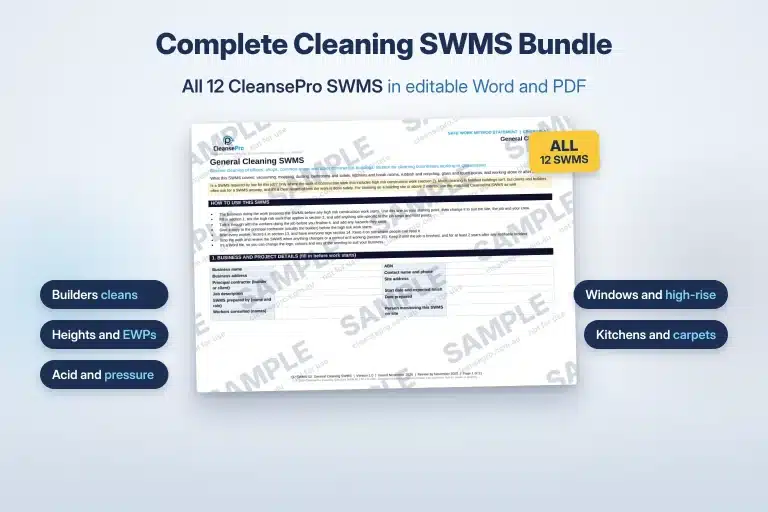
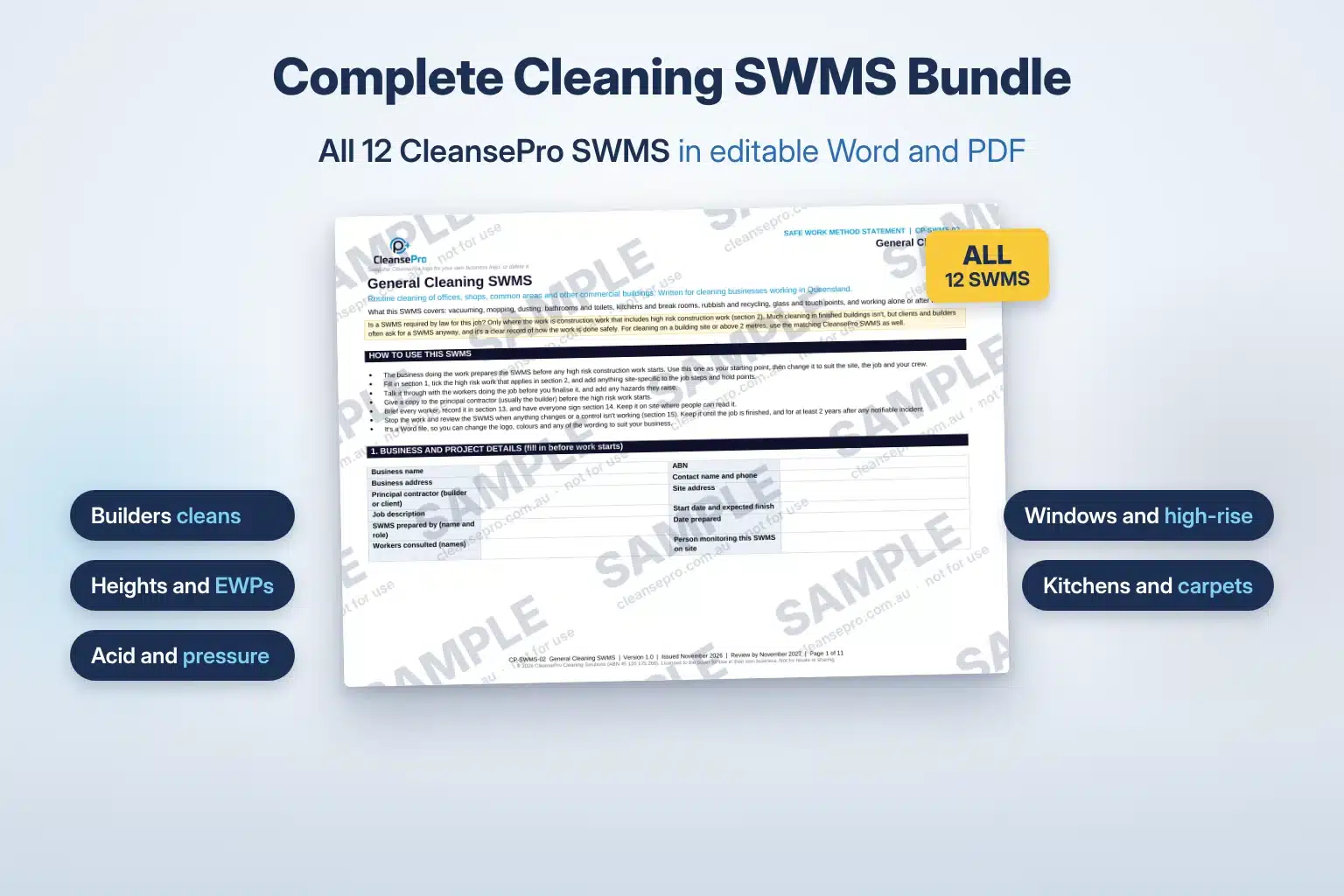
| Multiple task types | Complete Cleaning SWMS Bundle: all 12 for $99 |
If your cleaning business covers three or more task types, the Complete SWMS Bundle at $99 is the most cost-effective option, and gives you a task-specific document ready for every job type you take on.
Frequently Asked Questions
Is a SWMS the same as a risk assessment?
No. A risk assessment identifies hazards and rates their likelihood and consequence. A SWMS goes further: it specifies the exact control measures for each hazard and the step-by-step work sequence, in a format every worker can read and understand before starting. A risk assessment informs the SWMS. They are different documents that serve different purposes.
How long does a SWMS last before it needs updating?
Check a SWMS against every job rather than writing it once and reusing it unchanged. The site address, supervisor, hazards and emergency contacts should match the actual job each time. If conditions change or a control is not working, stop, review and update the SWMS, and brief the workers again before work continues.
Can a sole trader cleaning contractor use the same SWMS for multiple jobs?
Yes: the same template can be the starting point for multiple jobs. But the document must be customised for each specific site before work starts. A sole trader is a PCBU under the WHS Act and carries the same legal obligations as a larger cleaning business. Being a sole trader does not reduce the requirement.
Can I use a free SWMS template for cleaning work?
Yes: free templates from state regulators (WorkSafe QLD, SafeWork NSW, WorkSafe VIC) are a legitimate starting point. The limitation is that they are generic: not written for cleaning-specific hazards, task sequences, or applicable legislation references. They require significant customisation before they’ll satisfy a principal contractor or pass a WorkSafe inspection. Task-specific templates like CleansePro’s already have the job steps and controls written, so you mainly add your site details.
What happens if I don’t have a SWMS on site when required?
The principal contractor can refuse site access, stopping the job before it starts. Not preparing a SWMS for high risk construction work is an offence, with a maximum of 60 penalty units in Queensland, and WorkSafe inspectors can issue improvement or prohibition notices. Breaches of the wider safety duties in the WHS Act carry much larger fines.
A SWMS is not red tape. It is the document that gets your crew through the gate, protects them while they work, and protects your business if something goes wrong. For any cleaning contractor doing high risk construction work, it is non-negotiable.
👉 Browse CleansePro’s cleaning SWMS templates: from $9.99 →
Also read: What Are SWMS? A Cleaner’s Safety Guide → SWMS Template QLD: Complete Guide → Final Builders Clean SWMS: What It Must Include →
Written by CleansePro Team · Last updated November 2026