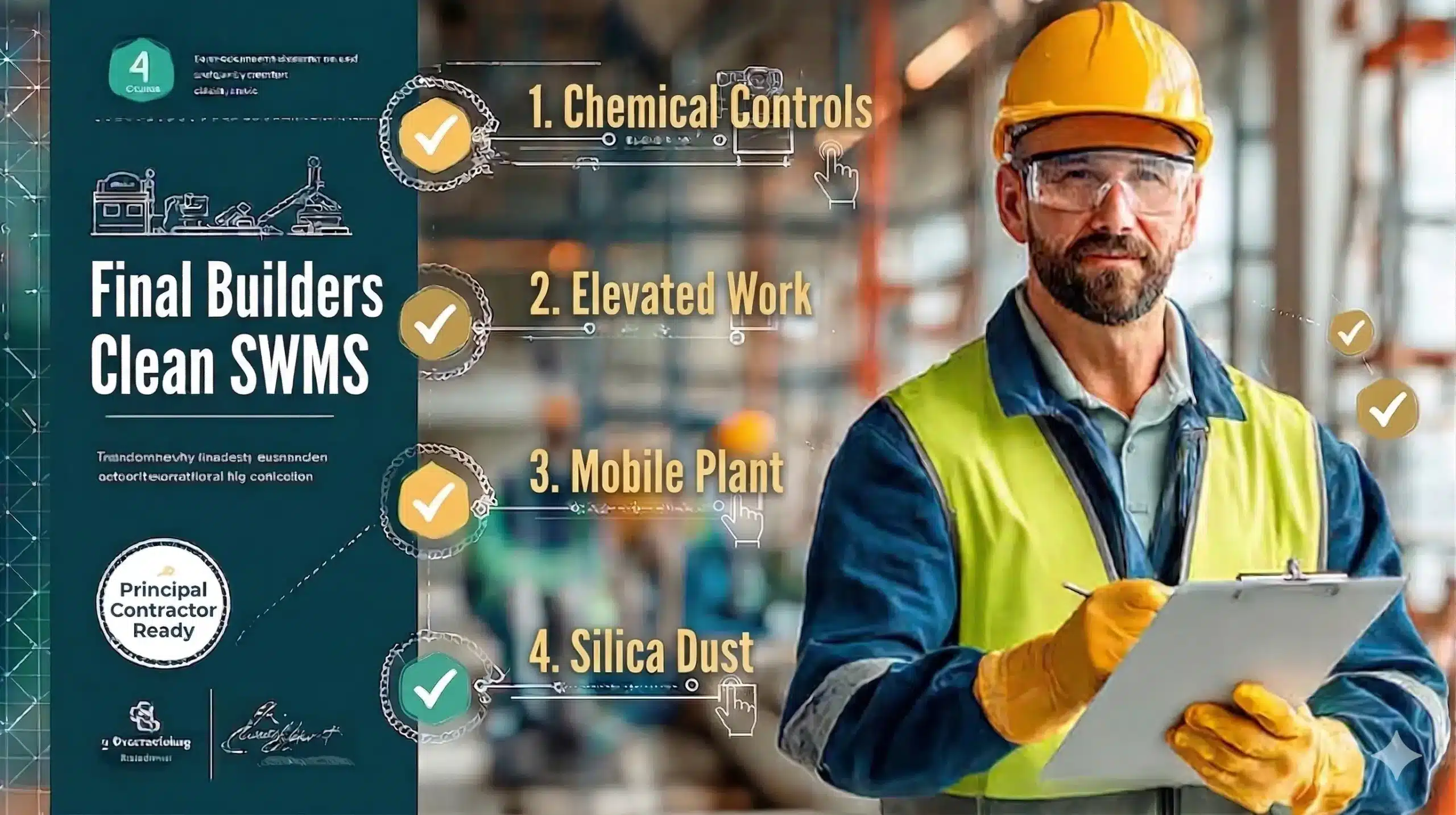
Final Builders Clean SWMS — What It Must Include (2026)
If you’re a cleaning contractor taking on post-construction work in Australia, your principal contractor will almost certainly ask for a Safe Work Method Statement before your crew sets foot on site. Not a generic one. A task-specific document that covers the actual hazards on a builders clean — chemicals, elevated work, mobile plant, construction dust.
This guide covers exactly what a Final Builders Clean SWMS must include under Australian WHS law, the mistakes that get documents rejected on site, and where to download a compliant, ready-to-edit template for $19.95.
Is a Final Builders Clean Classified as High-Risk Construction Work?
Yes — in most cases. And that’s the detail that trips up a lot of cleaning contractors.
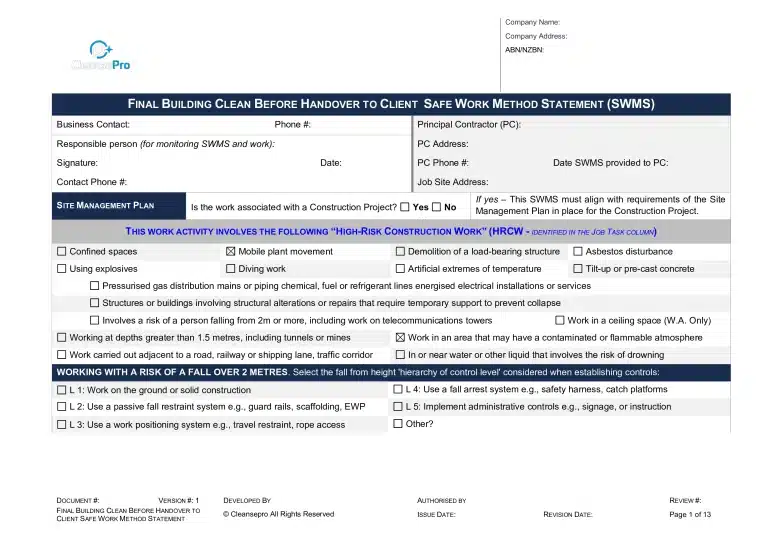
Under the Work Health and Safety Regulation 2017, High-Risk Construction Work (HRCW) triggers a mandatory SWMS requirement. A final builders clean commonly involves multiple HRCW categories:
- Working at heights above 2 metres (window cleaning, cleaning light fixtures, elevated surfaces)
- Use of powered mobile plant on the construction site
- Work adjacent to energised electrical services (not yet fully isolated on some sites)
- Use of hazardous chemicals requiring Safety Data Sheet (SDS) documentation
If your clean involves any one of these — and most post-construction cleans do — you are legally required to have a SWMS prepared and ready before work starts. The SWMS must be site-specific, not generic.
The practical reality: On Gold Coast construction sites, CleansePro submits a completed SWMS to the principal contractor before any crew enters the building. No document, no access. This isn’t just best practice — it’s how commercial building handovers actually work.
What a Final Builders Clean SWMS Must Cover
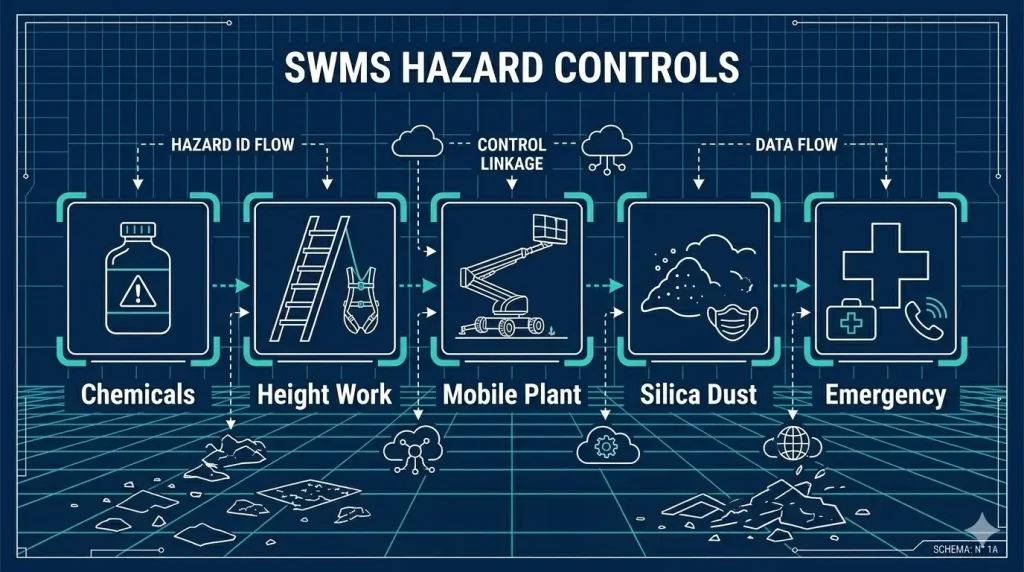
A compliant document needs to address every significant hazard your crew will encounter. Here’s what that means in practice for a builders clean specifically.
Chemical handling and SDS requirements
Post-construction cleans involve a range of heavy-duty cleaning chemicals — acid-based products for tile and grout, heavy degreasers, glass cleaning compounds. Your SWMS must:
- List every chemical being used on site
- Confirm that Safety Data Sheets are physically on site (not just accessible online)
- Specify PPE requirements for each chemical (gloves, eye protection, respiratory protection where required)
- Include spill response procedures
- Address storage and disposal of chemical waste
A SWMS that simply says “use appropriate PPE” without specifying what PPE for which chemical will not pass a thorough principal contractor review.
Elevated work controls
Cleaning internal windows, light fittings, high cornices, and ceilings on a multi-storey building puts your crew at height. Your SWMS must cover:
- The method of elevated work being used (ladder, step platform, EWP, scaffold access)
- Working at heights risk assessment and controls
- Fall prevention measures
- EWP pre-start checklist if an elevated work platform is being used
- High Risk Work Licence (HRWL) verification for EWP operators
If you’re using an EWP on the builders clean, your SWMS should reference the specific EWP controls — or you should carry a separate EWP SWMS alongside the builders clean document.
Mobile plant on construction sites
Construction sites often have cranes, forklifts, and other mobile plant operating during or shortly after the build phase. Your SWMS must address:
- Traffic management controls — where your crew can and cannot be when plant is operating
- Exclusion zones
- Communication procedures between cleaning crew and site supervisor
- High-visibility PPE requirements
Post-construction dust and silica hazards
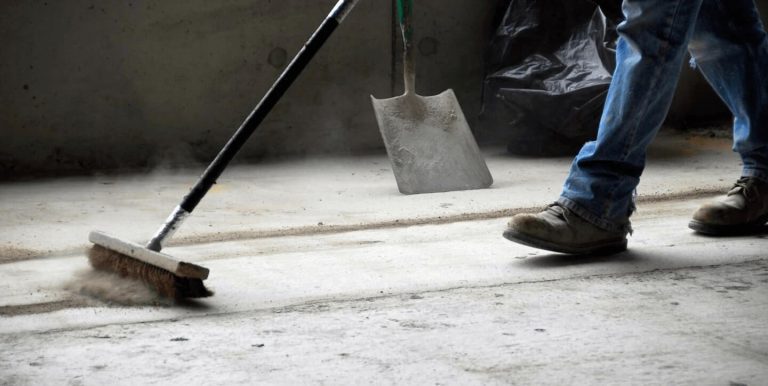
This is the control most generic SWMS templates miss entirely. Construction sites generate silica-containing dust from cutting concrete, bricks, and engineered stone. Even at the final clean stage, residual dust can be a serious respiratory hazard.
Your SWMS must include:
- Respiratory protection controls (P2 minimum for dusty environments)
- HEPA vacuum requirements (standard vacuums recirculate fine dust — HEPA captures it)
- Wet cleaning methods where appropriate
- Disposal of dust and construction debris
Emergency response
Every SWMS requires a documented emergency response procedure. For a final builders clean, this includes:
- Emergency contacts and site emergency assembly point
- Chemical spill response
- Medical emergency response
- Fire response (construction sites often have reduced fire system coverage until handover)
👉 Download the CleansePro Final Builders Clean SWMS — $19.95, instant delivery →
Fully editable Microsoft Word format. Add your logo, ABN, site details and supervisor name. Ready to submit to a principal contractor.
Free Template vs Paid SWMS — What’s the Real Difference?
This is worth being direct about, because free templates do exist online and you might be wondering whether they’re good enough.
| Free generic template | CleansePro Final Builders Clean SWMS | |
|---|---|---|
| Price | $0 | $19.95 |
| Task-specific to builders cleans | No | Yes |
| Silica dust controls included | Rarely | Yes |
| Chemical handling with SDS protocol | No | Yes |
| EWP and elevated work controls | No | Yes |
| Mobile plant controls | No | Yes |
| Emergency response module | Basic | Full |
| WHS legislation references | No | WHS Act 2011 + WHS Reg 2017 |
| Passes principal contractor review | Often rejected | Built to pass |
| Editable in Microsoft Word | Sometimes | Always |
| Unlimited use across all jobs | Sometimes | Yes |
The $19.95 difference is not the point. The point is that a rejected SWMS on a commercial builders clean site costs you a job, damages your relationship with the builder, and delays a project handover that a developer has a financial deadline on. One rejection costs far more than $19.95.
CleansePro vs SafetyDocs — Price and Value Comparison
SafetyDocs (safetydocs.safetyculture.com) is the most well-known SWMS provider in Australia. Their Final Building Clean Before Handover SWMS is priced at $89.95. CleansePro’s equivalent is $19.95.
| CleansePro | SafetyDocs | |
|---|---|---|
| Final Builders Clean SWMS | $19.95 | $89.95 |
| Fully editable Word format | Yes | Yes |
| WHS Act 2011 compliant | Yes | Yes |
| Cleaning industry specific | Yes | General construction focus |
| Written by active cleaning contractors | Yes | Safety document provider |
| Complete bundle (9 SWMS) | $99 | $89.95 per document |
The CleansePro documents are written by an active commercial cleaning company — not a generic safety software provider. The hazards we cover are the hazards our own crews deal with on Gold Coast builders cleans.
Common Mistakes That Get Builders Clean SWMS Documents Rejected
Principal contractors and their safety officers review a lot of SWMS documents. These are the most common reasons a cleaning contractor’s document gets sent back:
No site-specific information. A blank template with no project address, no site supervisor name, and no specific hazards identified isn’t a site-specific SWMS — it’s a document template. Fill in all fields before submitting.
Missing chemical SDS. Listing a product name without confirming SDS availability on site is a common audit failure. Your SWMS should state: “SDS for all chemicals listed are held on site in the site safety file.”
Generic PPE statements. “Appropriate PPE to be worn” is not acceptable. Specify what PPE, for which task, at which standard. Level 3 chemical-resistant gloves for acid-based products. P2 respirator for dusty environments. Safety glasses rated to AS/NZS 1337.
No emergency contacts. The site emergency number, assembly point, and nearest hospital must be on the document, not just referenced as “see site induction.”
Unsigned and undated. Every worker who reads and acknowledges the SWMS must sign it before starting work. An unsigned SWMS is an incomplete SWMS.
Frequently Asked Questions
Does every builders clean need a SWMS?
If the work involves High-Risk Construction Work (HRCW) — which most post-construction cleans do — yes, a SWMS is legally required under the WHS Regulation 2017. Even where it’s not strictly required by law, most principal contractors mandate a SWMS as a contractual condition of site access. If you’re cleaning a commercial build or a multi-unit residential development, assume a SWMS is required.
Can I use the same SWMS for multiple builders clean jobs?
You can use the same template, but your SWMS must be reviewed and updated for each site before work starts. The project address, site supervisor, site-specific hazards, and emergency contacts must reflect the actual job. The CleansePro template is in fully editable Microsoft Word format, so updating these details before each job takes less than 10 minutes.
Who signs the SWMS on a construction site?
The SWMS must be signed by every worker who will be performing the task before they start work. On a commercial builders clean this typically means every member of your cleaning crew, plus a site supervisor acknowledgement. Keep a copy on site throughout the job and retain a copy for your own records.
What’s the difference between a builders clean SWMS and a general cleaning SWMS?
A general cleaning SWMS covers routine cleaning tasks — vacuuming, mopping, surface wiping, bin emptying. A Final Builders Clean SWMS addresses the specific hazards of post-construction environments: construction dust and silica, heavy-duty chemicals, elevated work on incomplete structures, mobile plant, and emergency response on sites that may not have full fire and safety systems commissioned yet. They are not interchangeable.
A Final Builders Clean SWMS isn’t paperwork for its own sake. It’s what gets your crew on site, protects you if something goes wrong, and demonstrates to builders and developers that CleansePro operates professionally.
👉 Download the Final Builders Clean SWMS — $19.95, instant delivery →
Editable Word format. WHS Act 2011 compliant. Unlimited use across all your jobs.
Also need SWMS for other cleaning tasks? Browse the full range: EWP SWMS · Window Cleaning SWMS · Complete SWMS Bundle — all 9 documents for $99
Written by CleansePro Team · Last updated April 2026 · What is a SWMS? Read our plain-English guide →
{ “@context”: “https://schema.org”, “@type”: “Article”, “headline”: “Final Builders Clean SWMS — What It Must Include (2026)”, “description”: “What a Final Builders Clean SWMS must cover under Australian WHS law — chemicals, elevated work, mobile plant, silica dust and emergency response. Download a compliant template for $19.95.”, “author”: { “@type”: “Organization”, “name”: “CleansePro”, “url”: “https://cleansepro.com.au” }, “publisher”: { “@type”: “Organization”, “name”: “CleansePro”, “url”: “https://cleansepro.com.au” }, “mainEntityOfPage”: “https://cleansepro.com.au/best-cleaning-blog/final-builders-clean-swms-guide/”, “datePublished”: “2026-04-15”, “dateModified”: “2026-04-15”, “keywords”: “final builders clean swms, builders clean swms, construction cleaning swms australia” } { “@context”: “https://schema.org”, “@type”: “FAQPage”, “mainEntity”: [ { “@type”: “Question”, “name”: “Does every builders clean need a SWMS?”, “acceptedAnswer”: { “@type”: “Answer”, “text”: “If the work involves High-Risk Construction Work (HRCW) — which most post-construction cleans do — yes, a SWMS is legally required under the WHS Regulation 2017. Most principal contractors also mandate a SWMS as a contractual condition of site access regardless of legal requirements.” } }, { “@type”: “Question”, “name”: “Can I use the same SWMS for multiple builders clean jobs?”, “acceptedAnswer”: { “@type”: “Answer”, “text”: “You can use the same template, but your SWMS must be reviewed and updated for each specific site before work starts. The project address, site supervisor, site-specific hazards, and emergency contacts must reflect the actual job.” } }, { “@type”: “Question”, “name”: “Who signs the SWMS on a construction site?”, “acceptedAnswer”: { “@type”: “Answer”, “text”: “The SWMS must be signed by every worker performing the task before they start work — typically every member of your cleaning crew, plus a site supervisor acknowledgement. Keep a copy on site throughout the job.” } }, { “@type”: “Question”, “name”: “What is the difference between a builders clean SWMS and a general cleaning SWMS?”, “acceptedAnswer”: { “@type”: “Answer”, “text”: “A general cleaning SWMS covers routine tasks like vacuuming and mopping. A Final Builders Clean SWMS addresses post-construction hazards specifically: silica dust, heavy-duty chemicals, elevated work on incomplete structures, mobile plant, and emergency response on sites that may not have full safety systems commissioned.” } } ] }