What Are SWMS? A Cleaner’s Safety Guide Explained
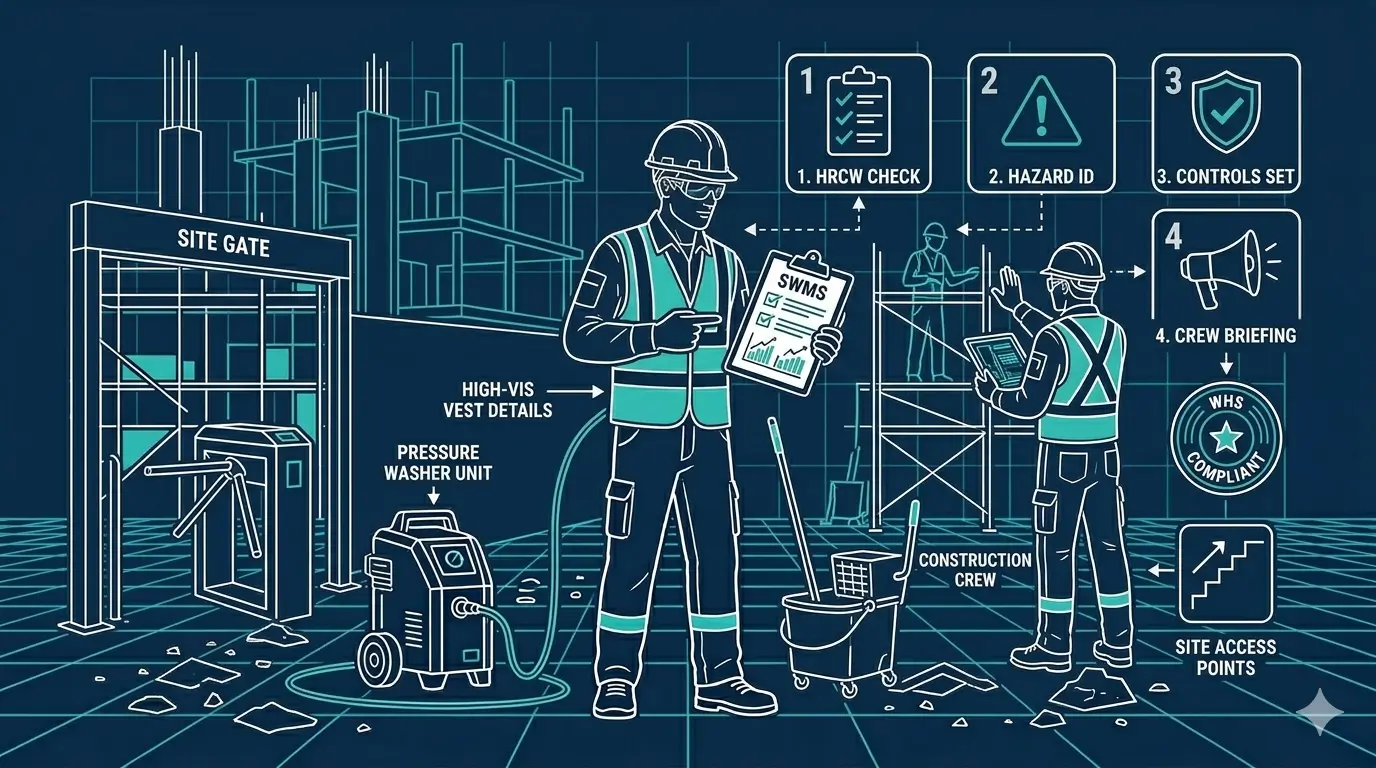
Picture this: a cleaning crew pulls up to a commercial construction site for a post-construction clean. The site supervisor meets them at the gate. “Where’s your SWMS?”
Most cleaning crews freeze.
If you’re asking the same question — what are SWMS, and why do they apply to cleaners — this guide answers it completely. What the document is, when it’s legally required, who prepares it, what must be inside it, and how to get yours right before your next commercial or builder clean.
What Are SWMS? The Plain-English Definition
A Safe Work Method Statement (SWMS) is a formal written document required under Australian WHS Regulations for any high-risk construction work (HRCW). It identifies the specific high-risk activities being performed, lists the hazards associated with each task step, and specifies exactly how those risks are controlled — before anyone picks up a mop, fires up a pressure washer, or accesses a scaffold.
It is a legal requirement — not a best-practice guideline and not an optional add-on.
SWMS vs JSA — these are not the same document
This is the most common point of confusion in the cleaning industry. A JSA (Job Safety Analysis) is a general risk identification tool used across many industries for routine or lower-risk tasks. It has no specific legal mandate under Australian WHS Regulations.
A SWMS, by contrast, carries direct legal weight and applies specifically to high-risk construction work. Both documents look similar in structure. But only one satisfies your legal obligation on a high-risk site — and using a JSA in place of a SWMS will not fool a WorkSafe inspector. They’ll identify the gap within minutes.
The 19 HRCW triggers that make a SWMS mandatory
Under Australian WHS Regulations, a task only needs to fall into one of these 19 categories to trigger the mandatory SWMS requirement:
- Fall risk above 2 metres
- Work in or near confined spaces
- Work near energised electrical installations
- Work involving powered mobile plant
- Demolition of load-bearing elements
- Work with explosives
- Near pressurised gas or chemical lines
- Near active traffic corridors
- Tilt-up or precast concrete work
- Shafts or trenches deeper than 1.5 metres
- Structural alterations requiring temporary support
- Contaminated or flammable atmospheres
- Artificial extremes of temperature
- Diving operations
- Asbestos disturbance
- Near water posing a drowning risk
- Work near pressurised fuel or refrigerant lines
- Near energised electrical services
- Work on telecommunication towers
One trigger is enough. Note: South Australia applies a 3-metre fall threshold rather than 2 metres — always check your state regulator’s specific requirements.
When Cleaning Work Requires a SWMS
Routine residential or office cleaning does not require a SWMS. The moment a cleaning crew moves into a construction environment or takes on work involving fall risks, confined spaces, or hazardous material exposure, the obligation kicks in.
Cleaning tasks that cross the HRCW threshold:
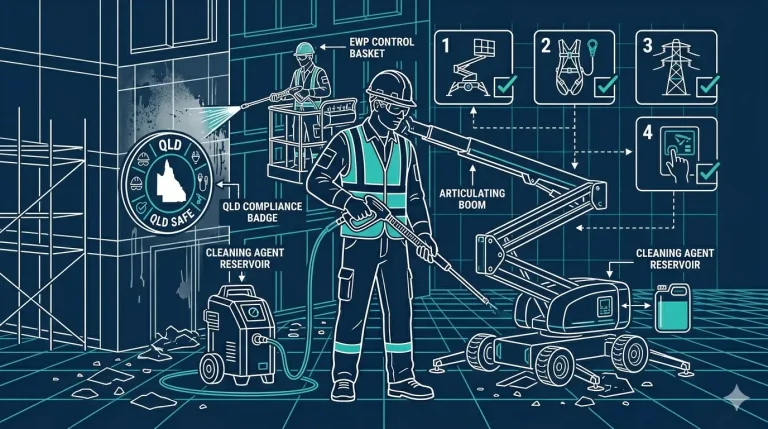
A builder clean on a multi-storey site where cleaners access elevated platforms or scaffolding crosses the 2-metre fall threshold immediately. Window cleaning from an EWP at 3–4 metres — HRCW. Cleaning inside storage tanks, industrial ducts, or enclosed plant rooms — HRCW. Post-construction cleaning near live electrical boards or in dusty low-visibility environments can trigger additional categories. On many sites, several HRCW categories apply simultaneously.
At CleansePro, SWMS documentation is built into every high-risk job brief. Across Gold Coast commercial and builder clean projects, our team has seen firsthand what happens when cleaning crews arrive on site without one — no access, no job, and an awkward conversation with the site supervisor that nobody wants.
Cleaning tasks that generally don’t require a SWMS:
Standard office cleaning. Ground-level commercial cleaning. Routine domestic house cleaning. These don’t trigger HRCW under the Regulations. That said, some principal contractors require a SWMS from every trade on site as a contractual condition of access — even for lower-risk work. Always check the site’s WHS management plan before arriving.
👉 Browse CleansePro’s task-specific SWMS templates — from $19.95, instant download →
Pre-filled for the real hazards on cleaning jobs. Editable Word format. Ready to submit to a principal contractor.
Who Is Responsible for Preparing a SWMS?
This is another common point of confusion — and getting it wrong puts your business at risk.
The cleaning contractor prepares their own SWMS.
The person conducting a business or undertaking (PCBU) is legally responsible for ensuring a SWMS is prepared before any HRCW begins. In most cleaning contexts, that means the cleaning contractor prepares the document for their own scope of work. The principal contractor (the builder running the site) reviews it for alignment with the site’s WHS management plan and monitors its implementation — but does not prepare it on your behalf.
If you arrive on site without a compliant SWMS, the principal contractor cannot legally allow your work to start. The compliance burden sits with your cleaning business. Not with the builder.
What workers must do before the job begins:
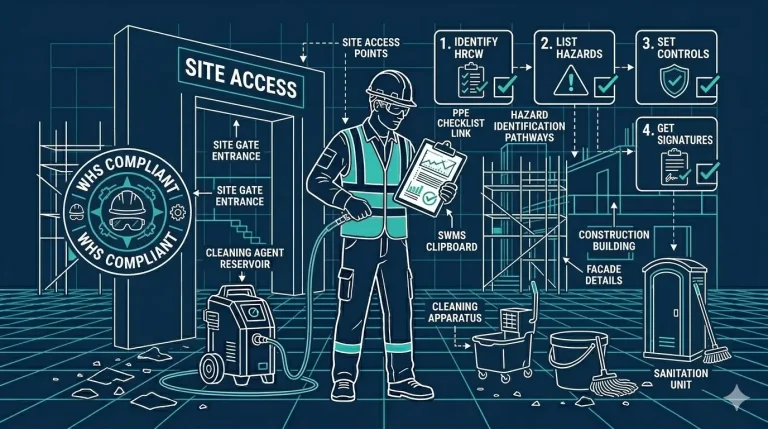
Workers must read and understand the SWMS before they start the task. In practice, this means signing the document to confirm they are aware of the identified hazards and the control measures in place. This is not a bureaucratic formality — it’s a regulatory expectation across all Australian states.
If a worker spots a hazard that isn’t covered in the document, they have the right and the obligation to raise it before proceeding. Work cannot continue until that gap is addressed and the SWMS is updated. Supervisors on site are responsible for enforcing compliance with the document at all times.
What Must Be Inside a Compliant SWMS?
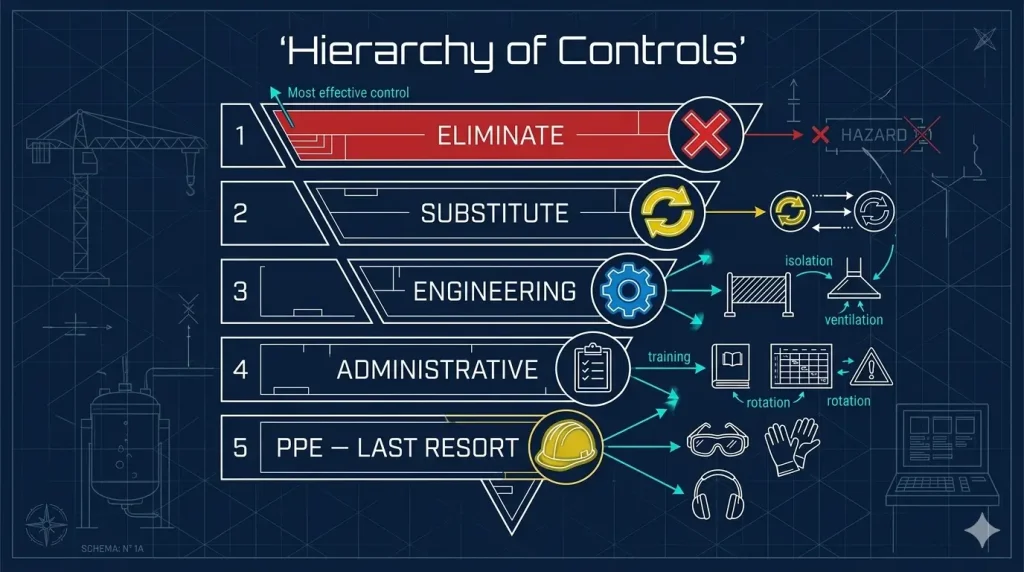
A compliant SWMS must contain all of the following. Missing even one element can mean the document fails a principal contractor review or a WorkSafe inspection on the spot.
The mandatory content:
- The type of HRCW being performed — clearly identified
- Each work task listed in logical, sequential steps
- The specific hazards associated with each task step
- Control measures for each hazard, ranked according to the hierarchy of controls:
- Elimination (remove the risk entirely)
- Substitution (replace with something less hazardous)
- Engineering controls (guardrails, HEPA filtration, exclusion zones)
- Administrative controls (safe work procedures, supervision, signage)
- PPE — the last resort, not the first response
- How controls will be implemented, monitored, and reviewed during the work
- Written in plain English — clear enough that any competent worker can follow without additional verbal instruction
The hierarchy of controls is not a suggestion. Regulators expect to see that higher-order controls were considered before defaulting to PPE. A SWMS that lists “wear gloves and hard hat” as the primary control for every hazard will not satisfy an inspector. Engineering controls — guardrails, dust suppression, exclusion zones — must appear before PPE wherever they are practicable.
The administrative details:
- PCBU name, ABN, and business address
- Responsible supervisor name and role
- Principal contractor name and project details
- Work site address
- Date the document was prepared
- Scheduled review date if conditions may change
- Signatures of every worker before work starts — with dates
How CleansePro Applies SWMS on Real Gold Coast Jobs
CleansePro teams working on commercial and builder clean jobs across the Gold Coast don’t treat the SWMS as an afterthought. Every team member on a high-risk job reviews and signs the relevant statement before a single tool is unloaded from the van.
Staff training incorporates completed SWMS examples drawn from real Gold Coast projects. New team members walk through finished documents before their first high-risk assignment — reviewing how hazards were identified and what controls were applied in actual site conditions. This means workers understand how to read a SWMS, flag gaps in it, and apply it on the day.
That practical familiarity is what separates a compliant crew from one that stops work when an inspector arrives.
Which Cleaning SWMS Does Your Job Actually Need?
A SWMS must be specific to the task. One generic document cannot cover a window clean, a pressure wash, and a confined space entry — each has its own distinct hazard profile and control requirements.
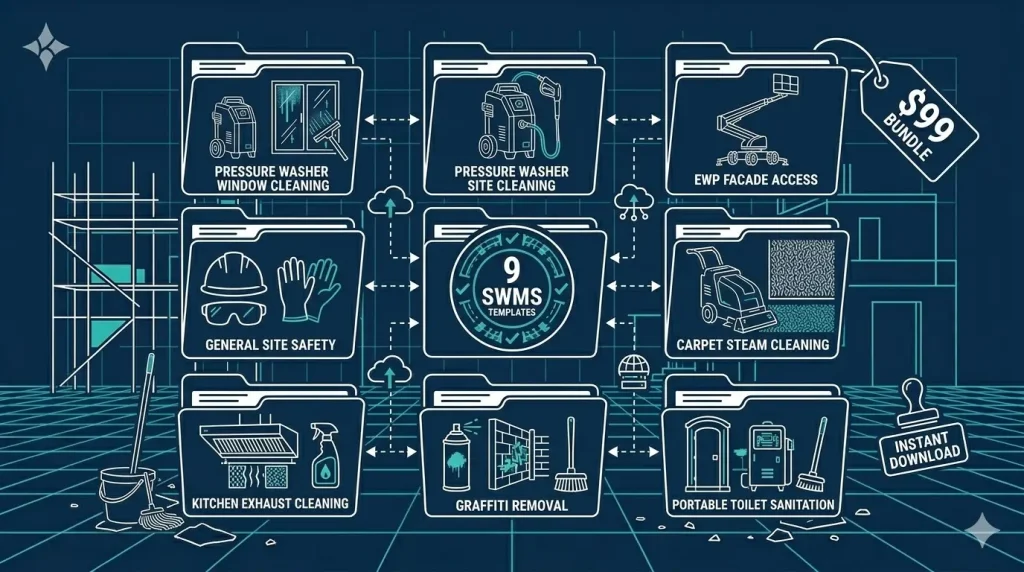
| Cleaning task | SWMS you need | Price |
|---|---|---|
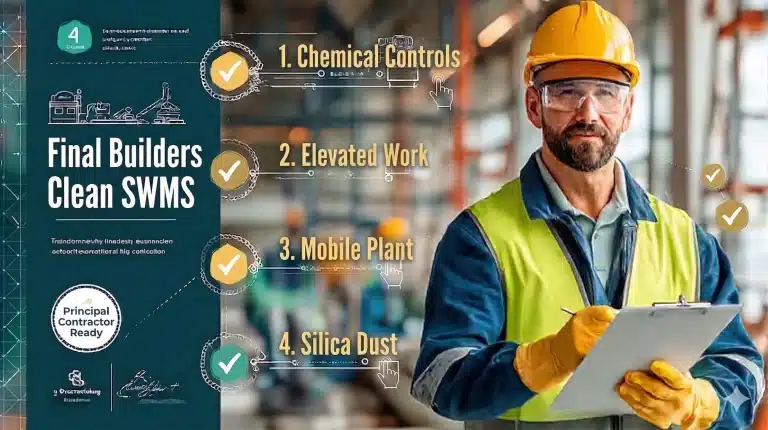
| Post-construction builders clean | Final Builders Clean SWMS | $19.95 |
| Window cleaning (EWP, rope access, water-fed pole) | Window Cleaning SWMS | $19.95 |
| EWP operation (boom lift, scissor lift) | EWP SWMS | $19.95 |
| High-rise rope access cleaning | High-Rise Cleaning SWMS | $19.95 |
| Pressure washing | Pressure Washing SWMS | $19.95 |
| Commercial kitchen cleaning | Commercial Kitchen Cleaning SWMS | $19.95 |
| Carpet cleaning (commercial) | Carpet Cleaning SWMS | $19.95 |
| Graffiti removal | Graffiti Removal SWMS | $19.95 |
| Porta-loo servicing | Porta-Loo Cleaning SWMS | $19.95 |
| Multiple task types | Complete SWMS Bundle — all 9 | $99.00 |
If your cleaning business covers more than three of these task types, the Complete SWMS Bundle at $99 saves you $80 compared to buying individually — and gives you a compliant document for every situation you’ll encounter.
Making SWMS Part of How You Operate
Understanding what SWMS are and building them into your standard pre-job process is not about ticking a compliance box. It’s about making sure every person on a high-risk cleaning job goes home safely — and making sure your business doesn’t get shut down, fined, or held liable when something goes wrong.
The document forces you to think through the task before work starts. That pre-job discipline is what the WHS Regulations are designed to create. For cleaning businesses operating in commercial, construction, or industrial environments, treating the SWMS as part of standard job preparation is the only sensible approach.
The safest assumption when assessing any new job: if the site has HRCW conditions present or likely, prepare the SWMS before you go. Check the 19 HRCW categories, assess the site, prepare the document, brief your crew, and start work with confidence.
Frequently Asked Questions
What is the difference between a SWMS and a JSA?
A SWMS (Safe Work Method Statement) is a legally mandated document under Australian WHS Regulations specifically for high-risk construction work. A JSA (Job Safety Analysis) is a general risk identification tool with no specific legal mandate under the WHS Regulations. They look similar in structure but only one satisfies your legal obligation on an HRCW site. Using a JSA in place of a SWMS will not pass a WorkSafe inspection.
Does a cleaning contractor need their own SWMS or does the builder provide one?
The cleaning contractor prepares their own SWMS for the work within their scope. The principal contractor (builder) reviews it for alignment with the site WHS management plan but does not prepare it on your behalf. The legal obligation sits with your cleaning business as the PCBU — not with the builder running the site.
Can one SWMS cover all the tasks on a builders clean?
It depends on the scope of work. A single SWMS can cover multiple task steps if they relate to the same HRCW category. However, if a builders clean involves both elevated work and confined space entry — two different HRCW categories — a separate SWMS or clearly delineated sections for each category is the safer approach. When in doubt, use task-specific documents.
Can a SWMS be stored on a phone or tablet instead of printed?
Yes — digital copies are generally acceptable provided the document is accessible to workers and available for inspection at any time during the job. Confirm the specific requirements with your state regulator, as requirements can vary marginally between jurisdictions. Keeping digital copies on a shared device that every crew member can access is a practical solution widely used by commercial cleaning businesses.
What happens if a worker refuses to sign the SWMS?
A worker who does not sign the SWMS has not confirmed they understand the hazards and controls for the task. Work should not commence until the issue is resolved — either through briefing the worker on the document content or addressing any legitimate concerns they raise about the identified controls. A SWMS without complete worker signatures is an incomplete document.
Understanding what SWMS are and making them part of your standard process is not a compliance burden — it’s a business asset. A cleaning contractor who arrives on site with a compliant, task-specific SWMS wins work that others lose at the gate.
👉 Download your task-specific cleaning SWMS — from $19.95, instant delivery →
Also read: Final Builders Clean SWMS — What It Must Include → · SWMS Template QLD — Complete Guide →
Written by CleansePro Team · Last updated April 2026
{ “@context”: “https://schema.org”, “@type”: “Article”, “headline”: “What Are SWMS? A Cleaner’s Safety Guide Explained”, “description”: “What are SWMS and when do Australian cleaners legally need one? Covers the 19 HRCW triggers, who prepares the document, what must be inside it, and which cleaning tasks require a task-specific SWMS.”, “author”: { “@type”: “Organization”, “name”: “CleansePro”, “url”: “https://cleansepro.com.au” }, “publisher”: { “@type”: “Organization”, “name”: “CleansePro”, “url”: “https://cleansepro.com.au” }, “mainEntityOfPage”: “https://cleansepro.com.au/best-cleaning-blog/what-are-swms/”, “datePublished”: “2026-04-04”, “dateModified”: “2026-04-08”, “keywords”: “what are swms, safe work method statement cleaning, swms for cleaners australia, hrcw cleaning” } { “@context”: “https://schema.org”, “@type”: “FAQPage”, “mainEntity”: [ { “@type”: “Question”, “name”: “What is the difference between a SWMS and a JSA?”, “acceptedAnswer”: { “@type”: “Answer”, “text”: “A SWMS (Safe Work Method Statement) is a legally mandated document under Australian WHS Regulations specifically for high-risk construction work. A JSA (Job Safety Analysis) is a general risk identification tool with no specific legal mandate under the WHS Regulations. Only a SWMS satisfies your legal obligation on an HRCW site — a JSA will not pass a WorkSafe inspection.” } }, { “@type”: “Question”, “name”: “Does a cleaning contractor need their own SWMS or does the builder provide one?”, “acceptedAnswer”: { “@type”: “Answer”, “text”: “The cleaning contractor prepares their own SWMS for the work within their scope. The principal contractor reviews it but does not prepare it on your behalf. The legal obligation sits with the cleaning business as the PCBU.” } }, { “@type”: “Question”, “name”: “Can one SWMS cover all the tasks on a builders clean?”, “acceptedAnswer”: { “@type”: “Answer”, “text”: “A single SWMS can cover multiple task steps relating to the same HRCW category. However, if a builders clean involves different HRCW categories — such as elevated work and confined space entry — a separate SWMS or clearly delineated sections for each category is the safer approach.” } }, { “@type”: “Question”, “name”: “Can a SWMS be stored on a phone or tablet instead of printed?”, “acceptedAnswer”: { “@type”: “Answer”, “text”: “Yes — digital copies are generally acceptable provided the document is accessible to workers and available for inspection at any time during the job. Confirm requirements with your state regulator as they can vary marginally between jurisdictions.” } }, { “@type”: “Question”, “name”: “What happens if a worker refuses to sign the SWMS?”, “acceptedAnswer”: { “@type”: “Answer”, “text”: “Work should not commence until the issue is resolved — either by briefing the worker on the document content or addressing legitimate concerns about the controls. A SWMS without complete worker signatures is an incomplete document.” } } ] }