If you’ve just been asked for a SWMS before starting a job and you’re not sure what one is — you’re not alone. A lot of cleaning contractors encounter this document for the first time when a site supervisor stops them at the gate and won’t let them in without one.
This guide explains exactly what a SWMS is, when Australian law requires it, what must be inside it, who is responsible for preparing it, and how to get a compliant one fast. No jargon. No filler.
What Does SWMS Stand For?
SWMS stands for Safe Work Method Statement. It’s a formal written document required under the Work Health and Safety Regulation 2011 before any high-risk construction work begins.
The document does three things:
- Identifies the specific high-risk activities involved in the task
- Lists the hazards associated with each step of the work
- Specifies exactly how each hazard will be controlled before anyone starts
It is a legal requirement — not a best-practice recommendation, not an optional extra, and not something you can approximate on the day with a verbal briefing. If the work triggers the mandatory requirement, you need a completed, signed SWMS on site before a single tool comes off the truck.
When Is a SWMS Legally Required in Australia?
The requirement is triggered by High-Risk Construction Work (HRCW). Under the WHS Regulation 2011, there are defined categories of work that automatically require a SWMS. Your task only needs to fall into one of them.
For cleaning contractors, the most common triggers are:
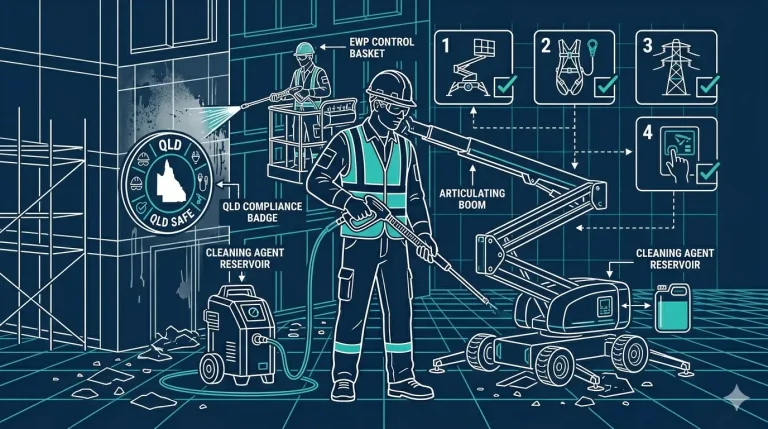
- Work at heights above 2 metres — window cleaning from an EWP, cleaning elevated surfaces on a construction site, roof cleaning
- Confined space entry — cleaning inside tanks, enclosed plant rooms, industrial ducts, or storage voids
- Work near energised electrical services — post-construction cleans where electrical systems are live but not yet fully commissioned
- Powered mobile plant operating nearby — construction sites where forklifts, cranes, or excavators are still moving
The key point: the trigger is the working conditions, not the cleaning task itself. A crew vacuuming dust from a building at 4 metres above ground needs a SWMS — not because vacuuming is dangerous, but because the elevated working environment crosses the HRCW threshold.
Routine office cleaning, standard residential cleaning, and ground-level commercial work generally do not require a SWMS. The moment construction environments, height, confined spaces, or hazardous substances enter the picture, the obligation applies.
What about Queensland specifically?
Queensland operates under the WHS Regulation 2011 (Qld), which mirrors the national framework with minor variations. For a detailed breakdown of QLD-specific requirements, fine amounts, and retention rules, read our SWMS Template QLD guide.
What Is the Difference Between a SWMS and a JSA?
This comes up constantly on construction sites and it matters to get right.
A JSA (Job Safety Analysis) is a general risk identification tool. It is used across many industries for routine or lower-risk tasks. It has no specific legal mandate under Australian WHS Regulations.
A SWMS carries direct legal weight under the WHS Regulation 2011. It applies specifically to HRCW. It has mandatory content requirements, mandatory sign-off requirements, and mandatory retention requirements.
Both documents look similar on the surface — hazards, controls, steps. But they are not interchangeable. Presenting a JSA to a WorkSafe inspector on an HRCW site will not satisfy your legal obligation. They will identify the gap immediately and work will stop.
If the work triggers HRCW, use a SWMS. Not a JSA. Not a general risk assessment. A SWMS.
What Must Be Inside a Compliant SWMS?

A SWMS that passes a principal contractor review or a WorkSafe inspection must contain all of the following. Missing even one element is grounds for rejection.
The mandatory content:
Task sequence — each step of the work listed in logical order from site setup to pack-down. For a builders clean, that might be: site induction → area setup → chemical handling → elevated cleaning → dust removal → site handover. Five to fifteen steps is typical.
Hazard identification — for each task step, the specific hazard must be named. Not “fall risk.” Not “chemicals.” The specific hazard: “unguarded edge at 3.5 metres during window cleaning from scissor lift” or “caustic degreaser contact risk during oven cleaning.” Vague descriptions fail audits.
Control measures — for each hazard, the controls applied must follow the hierarchy of controls in order:
- Eliminate the risk entirely where possible
- Substitute with something less hazardous
- Engineering controls — guardrails, exclusion zones, HEPA filtration, dust suppression
- Administrative controls — safe work procedures, supervision, signage, toolbox talks
- PPE — gloves, respirators, eye protection — as the last line of defence, not the first
Regulators expect to see higher-order controls considered before PPE is listed. A SWMS that defaults to “wear appropriate PPE” for every hazard will not satisfy an inspector.
Monitoring and review arrangements — how controls will be checked during the work. Pre-start inspections, daily toolbox talks, stop-work protocols if conditions change.
Administrative details:
- PCBU name, ABN, and business address
- Responsible supervisor name
- Principal contractor name and project details
- Work site address
- Date prepared
- Review date if conditions may change during the project
Worker signatures — every worker assigned to the task must sign before work starts, confirming they have read and understood the document. Dates on all signatures are non-negotiable.
👉 Download a task-specific cleaning SWMS — from $19.95, instant delivery →
Pre-filled for real cleaning tasks. Editable Word format. Ready to submit to a principal contractor today.
Who Prepares the SWMS — You or the Builder?
Your cleaning business prepares its own SWMS. Full stop.
Under the WHS Regulation 2011, the PCBU (Person Conducting a Business or Undertaking) is legally responsible for ensuring a compliant SWMS is prepared before HRCW begins. In a cleaning context, the PCBU is the cleaning contractor — not the principal contractor, not the developer, not the builder.
The principal contractor’s role is to review your SWMS for alignment with the site’s WHS management plan and to monitor its implementation on site. They do not prepare it for you. If you arrive without a compliant document, they cannot legally allow your work to start. The compliance obligation sits entirely with your business.
This is where a lot of cleaning contractors get caught. They assume the builder handles “all the safety paperwork.” The builder handles the site-wide WHS plan. Your scope of work — your SWMS — is yours.
SWMS vs Generic Free Templates — What’s the Real Difference?
Free SWMS templates are available online from government regulators, industry associations, and various safety websites. They are a legitimate starting point. Here’s the honest difference between a free generic template and a task-specific paid document.

| Free generic template | CleansePro task-specific SWMS | |
|---|---|---|
| Price | $0 | $19.95 |
| Specific to cleaning tasks | No | Yes |
| Pre-filled hazard controls | No | Yes |
| WHS legislation referenced | Sometimes | WHS Act 2011 + WHS Reg 2017 |
| Passes principal contractor review | Often rejected | Built to pass |
| Editable in Microsoft Word | Sometimes | Always |
| Unlimited use across all jobs | Sometimes | Yes |
| Time to complete | 1–3 hours | Under 10 minutes |
A free template requires you to identify every hazard, research every applicable control, and format it correctly — starting from a blank structure. For a cleaning contractor who has never written a SWMS before, that process typically takes hours and still produces a document that a site safety officer can pick apart.
A task-specific template pre-fills the hazards, controls, and legislation references relevant to that exact cleaning task. You add your business name, ABN, site details, and supervisor name — then you’re ready to submit.
The $19.95 difference is not the point. The point is that a rejected SWMS on the morning of a commercial job costs you the job, damages your relationship with the builder, and potentially triggers a regulatory visit. One rejection costs far more than $19.95.
Which SWMS Does Your Cleaning Business Actually Need?
The SWMS must be specific to the task. A window cleaning SWMS does not cover a confined space entry. A general cleaning SWMS does not cover EWP operation. Each high-risk task type needs its own document.
| Your cleaning task | The SWMS you need |
|---|---|
| Post-construction builders clean | Final Builders Clean SWMS — $19.95 |
| Window cleaning — EWP, rope access, water-fed pole | Window Cleaning SWMS — $19.95 |
| EWP operation — boom lift or scissor lift | EWP SWMS — $19.95 |
| High-rise rope access cleaning | High-Rise Cleaning SWMS — $19.95 |
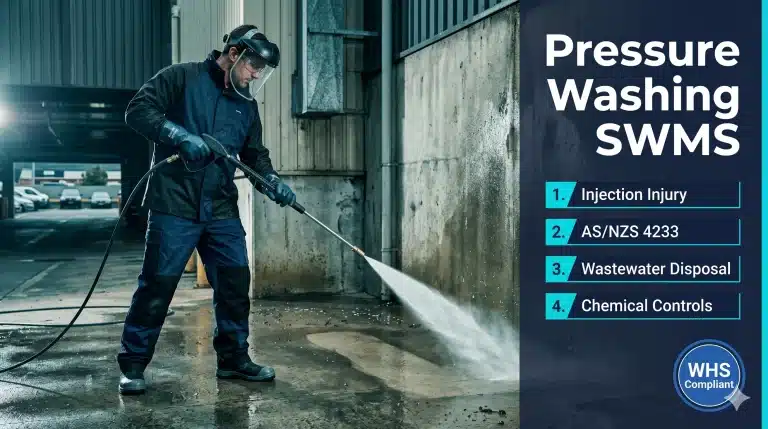
| Pressure washing | Pressure Washing SWMS — $19.95 |
| Commercial kitchen cleaning | Commercial Kitchen Cleaning SWMS — $19.95 |
| Carpet cleaning (commercial) | Carpet Cleaning SWMS — $19.95 |
| Graffiti removal | Graffiti Removal SWMS — $19.95 |
| Porta-loo servicing | Porta-Loo Cleaning SWMS — $19.95 |
| Multiple task types | Complete SWMS Bundle — all 9 for $99 |
If your cleaning business covers three or more task types, the Complete SWMS Bundle at $99 is the most cost-effective option — and gives you a compliant, task-specific document ready for every job type you take on.
Frequently Asked Questions
Is a SWMS the same as a risk assessment?
No. A risk assessment identifies hazards and rates their likelihood and consequence. A SWMS goes further — it specifies the exact control measures for each hazard and the step-by-step work sequence, in a format that every worker must read and sign before starting. A risk assessment informs the SWMS. They are different documents that serve different purposes.
How long does a SWMS last before it needs updating?
A SWMS must be reviewed before every job — not just written once and reused indefinitely. The site address, site supervisor, specific hazards, and emergency contacts must reflect the actual job each time. If site conditions change significantly during a job, the SWMS must be reviewed, updated, and re-briefed to all workers before work continues.
Can a sole trader cleaning contractor use the same SWMS for multiple jobs?
Yes — the same template can be the starting point for multiple jobs. But the document must be customised for each specific site before work starts. A sole trader is a PCBU under the WHS Act and carries the same legal obligations as a larger cleaning business. Being a sole trader does not reduce the requirement.
Can I use a free SWMS template for cleaning work?
Yes — free templates from state regulators (WorkSafe QLD, SafeWork NSW, WorkSafe VIC) are a legitimate starting point. The limitation is that they are generic — not written for cleaning-specific hazards, task sequences, or applicable legislation references. They require significant customisation before they’ll satisfy a principal contractor or pass a WorkSafe inspection. Task-specific templates like CleansePro’s reduce that customisation time to under 10 minutes.
What happens if I don’t have a SWMS on site when required?
The principal contractor can refuse site access immediately — stopping your job before it starts. WorkSafe inspectors can issue improvement notices or prohibition notices requiring work to stop until a compliant document is in place. Fines for a PCBU can reach into the hundreds of thousands of dollars depending on the breach category and state. The practical and financial consequences of not having a compliant SWMS far outweigh the cost and time of preparing one.
A SWMS is not red tape. It is the document that gets your crew through the gate, protects them while they work, and protects your business if something goes wrong. For any cleaning contractor working in construction environments, commercial sites, or any setting that involves HRCW conditions — it is non-negotiable.
👉 Browse CleansePro’s cleaning SWMS templates — from $19.95 →
Also read: What Are SWMS? A Cleaner’s Safety Guide → SWMS Template QLD — Complete Guide → Final Builders Clean SWMS — What It Must Include →
Written by CleansePro Team · Last updated April 2026