Dental Office Cleaning Services: Compliance Guide & Costs
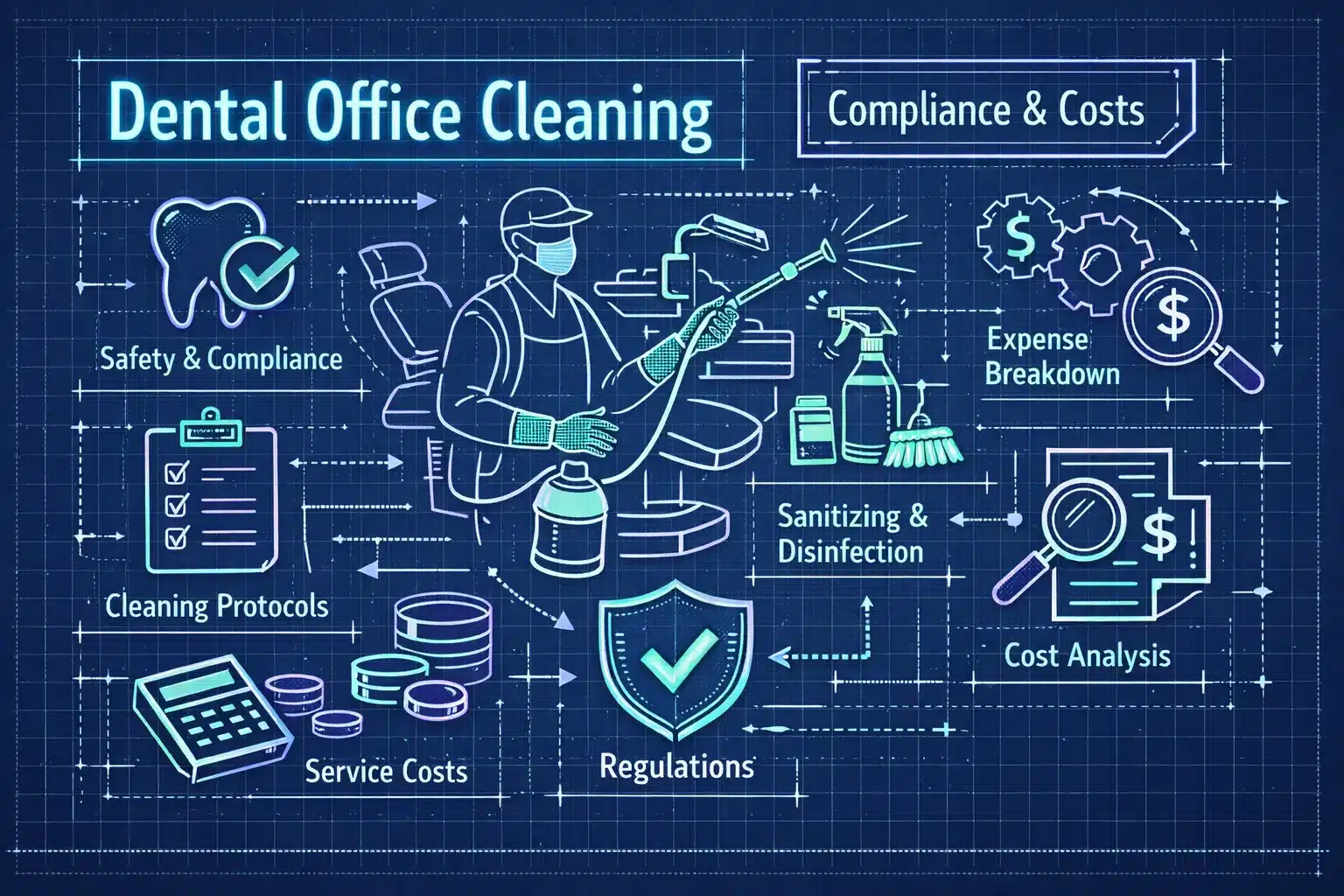
Cleaning services for dental offices must meet a higher compliance threshold than standard commercial janitorial work, and the gap between the two is wider than most practice owners realize. Patients trust you with their health, their comfort, and their safety. But if the cleaning contractor you hired last quarter isn’t trained in CDC infection-control protocols, that trust has a gap in it you can’t see from the front desk. Standard commercial janitorial service is not built for dental environments. It doesn’t account for blood-borne pathogen exposure, aerosol contamination zones, clinical contact surfaces, or the EPA-registered disinfectants that CDC and EPA guidance requires for healthcare settings. The difference between a compliant clean and a general clean isn’t cosmetic. It’s regulatory, clinical, and in some states, it affects your license.
At CleansePro, we’ve spent years refining medical and commercial cleaning protocols for healthcare settings, including dental practices, clinics, and high-compliance environments where getting it wrong isn’t an option. This guide covers the compliance framework your cleaning vendor must meet, the certifications to verify, what compliant service actually costs in 2025, and the exact questions to ask before you sign a contract.
Why dental practices can’t use a standard cleaning service
The infection-control gap most offices don’t see
General commercial cleaning crews are trained to make spaces look clean. That’s not the same as making them clinically safe. A standard janitorial team mopping your operatory floor with a general-purpose cleaner has no training in CDC healthcare guidelines, no knowledge of which surfaces qualify as clinical contact zones, and no understanding of what OSHA’s 29 CFR 1910.1030 bloodborne pathogen standard requires from anyone working in your space. Dental environments generate saliva, blood, and aerosol exposure that create real contamination risk between patients.
The problem is that most practice owners don’t find out their cleaning vendor is non-compliant until an infection-control audit, a staff complaint, or a patient incident forces the issue. By that point, the documentation gap is already a liability. A cleaning company that markets itself as a “healthcare cleaner” without holding the training and certifications to back that claim is not a compliant vendor. It’s a risk dressed up in a logo.
What the CDC, OSHA, and ADA actually require
Three agencies govern how your operatories must be cleaned. The CDC’s Summary of Infection Prevention Practices in Dental Settings (updated 2016, incorporating 2003 standards) sets the clinical benchmark: EPA-registered hospital-grade or intermediate-level disinfectants on all clinical contact surfaces, with surfaces cleaned before disinfection and barriers changed between patients. OSHA enforces the bloodborne pathogen standard, requiring a written Exposure Control Plan, annual BBP training for all staff with exposure risk, and PPE provision for anyone cleaning in contaminated zones, including your contractor’s crew.
For a detailed review of operatory preparation and sterilization practices, see operatory preparation and sterilization practices.
The ADA aligns with CDC guidance and endorses EPA-registered, hospital-level disinfectants as the standard for operatory surfaces. There is also a critical surface distinction that affects cleaning frequency: clinical contact surfaces, such as chairs, bracket trays, and delivery unit controls, require between-patient cleaning and disinfection, while housekeeping surfaces like floors and sinks require daily cleaning but only need disinfection when visibly soiled. A vendor who treats every surface identically is not following the framework.
Cleaning services for dental offices: hospital-grade disinfection protocols
Clinical contact surfaces: the between-patient standard
The required process for clinical contact surfaces is two steps, not one. First, clean to remove physical debris: blood, saliva, dental materials. Disinfectants cannot penetrate through organic matter, so skipping the cleaning step renders disinfection ineffective regardless of which product you use. Second, apply an EPA-registered hospital-grade or intermediate-level disinfectant and maintain wet contact time per the product label, typically one to ten minutes depending on the formulation.
Surface barriers on hard-to-clean items like chair switches and computer equipment must be changed between every patient. If a barrier is removed and the surface underneath is visibly contaminated, that surface must be cleaned and disinfected before the next patient enters the room. This is the operational baseline, not an enhanced protocol. CleansePro’s medical cleaning teams use EPA-registered disinfectants and follow documented surface protocols trained to this exact standard, the benchmark every compliant dental cleaning vendor should meet.
Dental unit waterlines, handpieces, and sterilization zones
Dental unit waterlines must be flushed for 20 to 30 seconds at the start of each day and between patients to reduce microbial load. The accepted threshold is 500 CFU/mL, consistent with EPA drinking water standards. Handpieces have manufacturer-specific cleaning and sterilization requirements that must be followed exactly: many cannot be cleaned with alcohol, and internal cleaning protocols differ from external surface wipe-downs.
Sterilization zones require staff trained in instrument tracking, ultrasonic cleaner use, and autoclave operation. Any cleaning vendor whose crew enters these areas should carry documented training on equipment-specific protocols. Recent reviews of infection prevention in dental settings provide more detail on instrument processing and environmental controls. Generalist cleaning companies rarely have this training, and it’s one of the clearest dividing lines between a compliant medical cleaning specialist and a standard janitorial service operating in a healthcare setting.
Approved disinfectant classes and when to use each
EPA-registered disinfectant categories used in dental settings include quaternary ammonium compounds, sodium hypochlorite, hydrogen peroxide, phenolics, and hypochlorous acid. For visibly blood-contaminated surfaces, the requirement steps up: you need an intermediate-level tuberculocidal disinfectant proven effective against Mycobacterium tuberculosis. Lower-level products rated against HIV and HBV are acceptable for non-blood-contaminated clinical contact surfaces, but they are not interchangeable with intermediate-level products when contamination is visible.
Undiluted household bleach products without proper EPA hospital-grade registration are not acceptable substitutes, always verify EPA registration numbers on product labels before approving any disinfectant for operatory use. High-level sterilants like glutaraldehyde are FDA-regulated and reserved for critical instruments, not surface disinfection. Any vendor who can’t articulate this distinction during a pre-contract conversation is telling you something important about their training.
Certifications and insurance your cleaning vendor must carry
Healthcare cleaning credentials to verify before signing
The IJCSA Medical Cleaning Certification (MCC) is the most directly relevant recommended credential for cleaning crews working in dental offices. It covers CDC and OSHA infection prevention guidelines, disinfection protocols, terminal cleaning procedures, and the specific requirements of healthcare environments. Any crew member cleaning operatories or sterilization zones should hold this or an equivalent credential, though legal requirements vary by state, so confirm what your jurisdiction mandates.
OSHA Bloodborne Pathogen Training is required for anyone with occupational exposure risk in your space. Under 29 CFR 1910.1030, the dental practice shares legal liability if a contractor’s crew lacks this training. For vendors whose staff interface with sterilization areas, DANB’s Certified in Dental Infection Prevention and Control (CDIPC) provides dental-specific coverage that goes beyond general medical cleaning. Industry coverage explaining why medical cleaning certification matters can help you evaluate vendor claims. Request OSHA BBP training documentation as a non-negotiable, and consider IJCSA MCC and DANB CDIPC credentials as strong indicators of specialization, then confirm any additional requirements with your state dental board.
Insurance coverage and background-check requirements that protect your practice
General liability insurance with a minimum of $1,000,000 per occurrence and $2,000,000 aggregate is the baseline for a commercial cleaning contractor working in a dental environment. This covers slip-and-fall incidents, equipment damage, and property claims. Workers’ compensation coverage protects you from liability if a contractor’s employee is injured on your premises. Fidelity bonding provides protection against theft or negligence by contractor staff in a setting where sensitive patient information and expensive equipment are present.
CleansePro carries substantial public liability coverage and deploys background-screened staff on every clean, meeting the verified, fully insured standard your practice deserves. Before any cleaning contractor begins work in your office, request a current Certificate of Insurance naming your practice as an additional insured. A vendor who hesitates on this request is not a vendor built for healthcare compliance. Learn more About CleansePro, Gold Coast Cleaning Experts.
Checklist for cleaning services for dental offices: daily, weekly, and deep-clean tasks
Between-patient and daily cleaning tasks
The daily cleaning framework for a compliant dental office covers two layers. Between patients, the scope includes changing all surface barriers, cleaning and disinfecting all clinical contact surfaces with an EPA-registered disinfectant, and inspecting any barrier-removed surfaces for contamination before the next patient. At end of day, the scope expands: wiping down all operatory surfaces, mopping floors with disinfectant solution, flushing waterlines and suction lines, sanitizing traps, and removing all clinical waste per regulated disposal requirements.
This isn’t a discretionary checklist. It is the operational minimum required by the CDC/OSHA framework, and your cleaning vendor should document completion of these tasks at every visit, not just on request. Maintaining written or digital quality records after each clean gives you a verifiable log that supports your practice during inspections and regulatory audits.
Weekly and monthly deep-cleaning tasks
The tasks most general cleaning companies skip are the ones that compound over time. Monthly tasks include deep-cleaning chair upholstery to prevent biofilm buildup, scrubbing drain buildup and grout in wet areas, and thoroughly cleaning handpiece tubing. Additional monthly priorities include vacuuming HVAC vents, polishing partitions, and reviewing any carpeted areas (with removal recommended where possible, per CDC guidance on non-porous flooring).
A medical cleaning specialist builds these tasks into a scheduled rotation from day one. They are not add-ons negotiated later; they are part of a compliance-first cleaning program. If a vendor’s quote doesn’t include them, ask specifically what their weekly and monthly scope covers before signing anything. You can also review our office cleaning resources for examples of scheduled rotations and task lists.
What dental office cleaning services typically cost in 2025
Factors that affect your cleaning quote
Pricing for professional dental clinic cleaning services depends on square footage, number of operatories, cleaning frequency, and whether the scope includes add-ons like consumables restocking and office hygiene supplies or periodic deep-sanitization visits. A quote that comes in well below market rate is usually missing one or more of these components: certified crews, EPA-registered disinfectants, and documented compliance protocols all carry real cost, and compliant commercial dental cleaning commands a premium over standard janitorial work for that reason.
Regional price benchmarks to expect
Based on current market data, the 2025 national range for a routine professional dental practice cleaning visit falls between $100 and $250 per visit. Regional variation is significant. Northeast and West Coast markets tend to run higher, between $125 and $325, reflecting elevated labor and operating costs. South and Midwest markets typically range from $75 to $200 for routine visits, though individual state averages vary. Deep-sanitization visits carry separate per-visit pricing above the routine maintenance rate.
The most important point about pricing: the lowest quote in your shortlist is rarely the compliant one. When a vendor undercuts the market by 30 to 40 percent, the savings commonly come from somewhere identifiable, uncertified staff, lower-grade disinfectants, skipped protocols, or absent liability coverage. In a dental environment where the regulatory stakes are this specific, price is not the right primary filter.
Questions to ask before you hire a dental cleaning company
Protocol and training questions that reveal true expertise
When you interview cleaning vendors, ask directly and don’t accept vague answers about “healthcare experience.” The questions that separate compliant vendors from those who market healthcare cleaning without the credentials include:
- What EPA-registered disinfectants do you use, and can you confirm they are appropriate for dental clinical contact surfaces?
- How do you train staff on bloodborne pathogen exposure, and how often is that training updated?
- What is your between-patient surface protocol for operatories, step by step?
- Do your crew members hold IJCSA Medical Cleaning Certification or equivalent healthcare cleaning credentials?
- Can you describe the difference between clinical contact surfaces and housekeeping surfaces and how your cleaning schedule addresses each?
A vendor who answers all five with specificity and documentation is worth further evaluation. A vendor who gives you a general answer about “hospital-grade products” without naming the disinfectant class or certification is not ready for a dental environment.
Credential, coverage, and guarantee questions that protect your practice
The second set of questions focuses on accountability and protection. Ask every vendor: Can you provide a current Certificate of Insurance showing general liability at $1M per occurrence and workers’ compensation coverage? Are your staff background-screened before assignment? Do you provide quality reports after each clean? What is your re-clean or satisfaction guarantee policy?
CleansePro is built to answer every one of these questions with documentation. Background-screened teams, substantial public liability coverage, medical cleaning accreditation, and quality reports after every visit are built into how we operate, not offered as optional upgrades. Requesting a Certificate of Insurance before work begins is a strong best practice; any vendor unwilling to provide one is a serious red flag for a healthcare environment.
Compliance is the baseline, not the bonus
Dental office cleaning is a clinical compliance requirement, and the vendor you hire either meets the standard or creates a liability gap you can’t afford. The framework is clear: CDC-aligned disinfection protocols, OSHA bloodborne pathogen training for every crew member, EPA-registered disinfectants matched to surface type, and verifiable records of certifications and insurance before any crew sets foot in your operatory.
The evaluation criteria are straightforward. Check certifications before you sign. Verify insurance with a current COI. Ask protocol questions that require specific answers. Confirm a written satisfaction guarantee. A cleaning partner who clears all of these filters confidently is one who protects your patients, your staff, and your practice license, not just the appearance of your floors.
Contact CleansePro today for a compliant dental cleaning assessment of your practice. Our team brings healthcare cleaning expertise, verified credentials, and the documented protocols your practice needs to stay inspection-ready, get a quote now and see what cleaning services for dental offices should actually look like. Learn more About CleansePro.