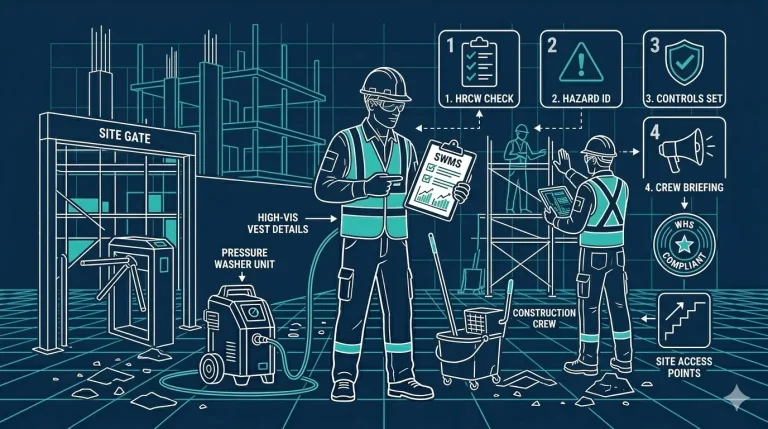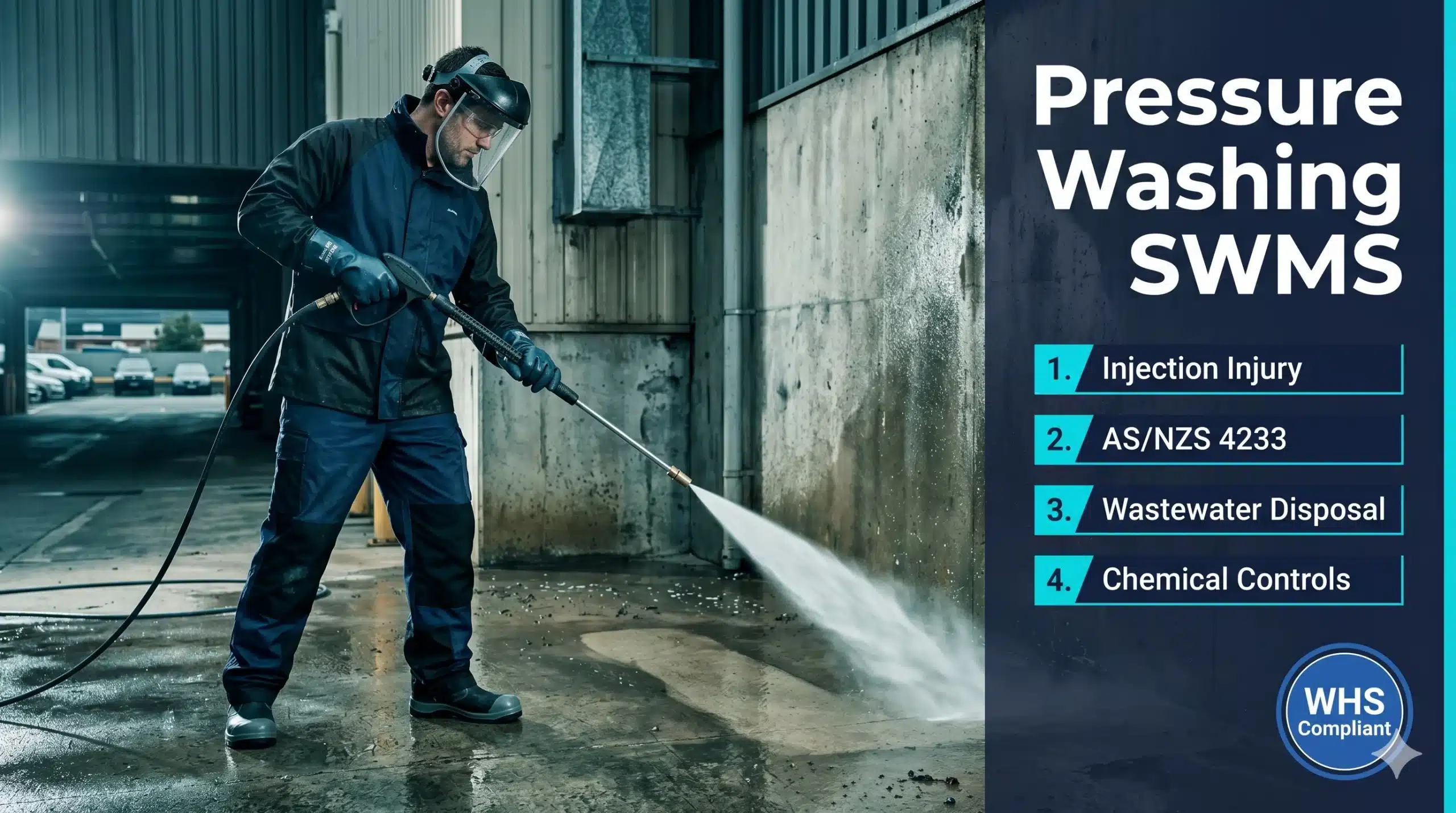
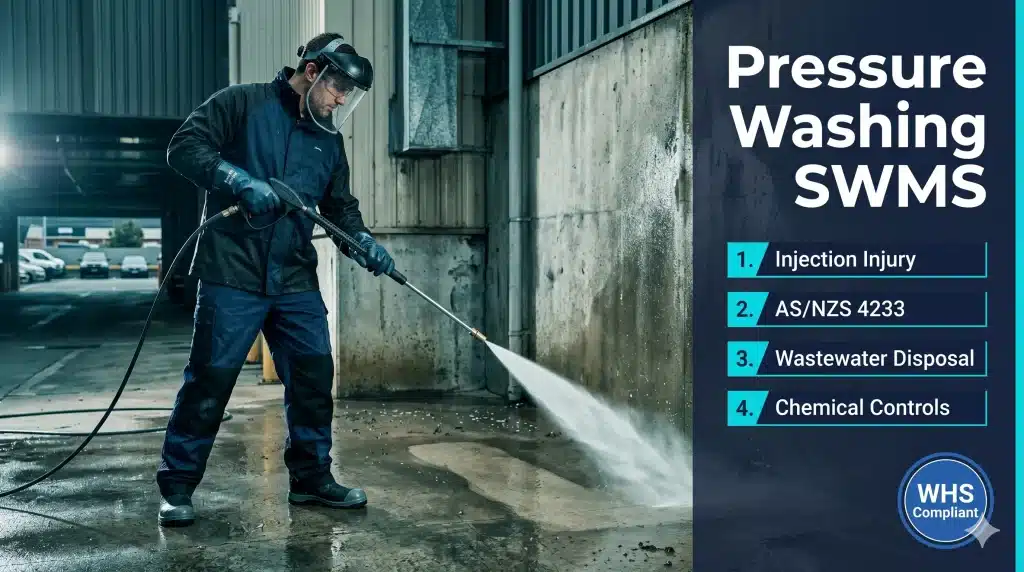
Pressure Washing SWMS Australia — When You Need One and What It Must Cover
Pressure washing looks like one of the simpler cleaning tasks. Point the gun, pull the trigger, rinse off the surface. In practice, high-pressure cleaning equipment generates enough force to inject water, cleaning chemicals, or contaminants directly through skin — and that injury can occur before the operator feels anything. On a construction site or in a commercial setting, a Pressure Washing SWMS is a legal requirement. In any setting, the specific hazards it covers can be the difference between a routine job and a serious injury.
This guide covers exactly when a Pressure Washing SWMS is legally required in Australia, the injection injury risk that most generic templates barely mention, wastewater disposal obligations that could expose your business to EPA liability, and what a compliant document must include before you pick up the lance.
When Is a Pressure Washing SWMS Legally Required?
The requirement depends on where you’re working and what conditions surround the task — not simply on the equipment being used.
On a construction site — always required
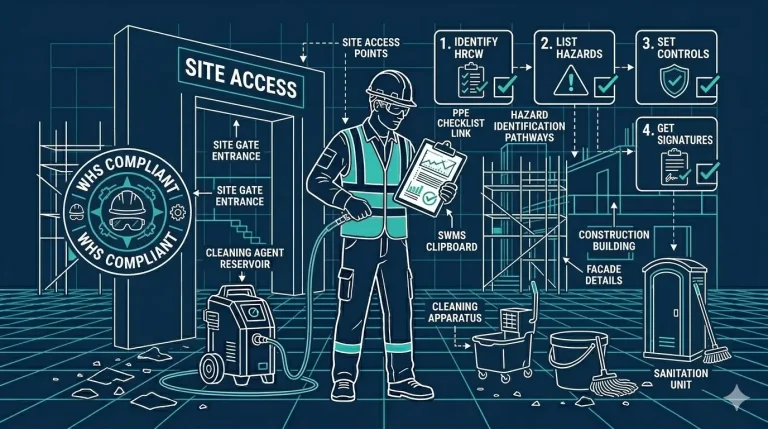
Any pressure washing work on an active or recently completed construction site involves HRCW conditions by default. Powered mobile plant, energised electrical services, fall risks from elevated surfaces, and contaminated atmospheres are all commonly present. If you’re pressure washing on a construction site, prepare a SWMS before work starts regardless of what specific surface you’re cleaning.
Working at height — required
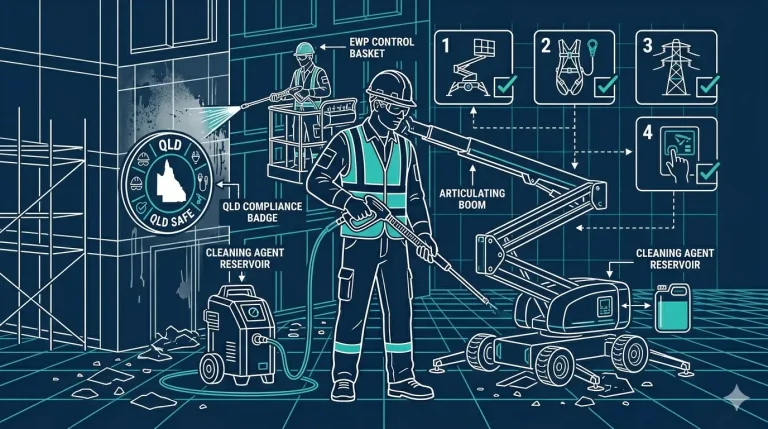
Pressure washing on scaffolding, from an EWP, or on any elevated surface above 2 metres triggers the height-related HRCW category. Your Pressure Washing SWMS and your EWP SWMS should be carried together on any job that combines elevated access with high-pressure cleaning.
Commercial and industrial settings — required by contract
Many facilities managers, strata managers, and commercial property operators require a SWMS as a contractual condition of access for any pressure washing work on their property — regardless of whether a strict legal obligation exists. Car parks, loading docks, commercial kitchen exteriors, and industrial facilities are the most common settings where this contractual requirement applies.
Domestic driveways and residential work — generally not required
A sole trader pressure washing a residential driveway at ground level with no HRCW conditions present does not trigger a mandatory SWMS under the WHS Regulation 2011. However, a safe work procedure is still strongly recommended — particularly given the injection injury risk inherent in the equipment — and may be required by your public liability insurer.
The honest advice: if you’re unsure whether your job requires a SWMS, assess the site conditions. If a construction environment, height work, commercial setting, or hazardous substances are involved — prepare the document. The cost of being wrong without one is far higher than the 10 minutes it takes to complete a task-specific template.
Injection Injury — The Pressure Washing Hazard Most SWMS Templates Miss
This is the section that separates a genuine Pressure Washing SWMS from a generic template with “pressure washing” typed into the title field.
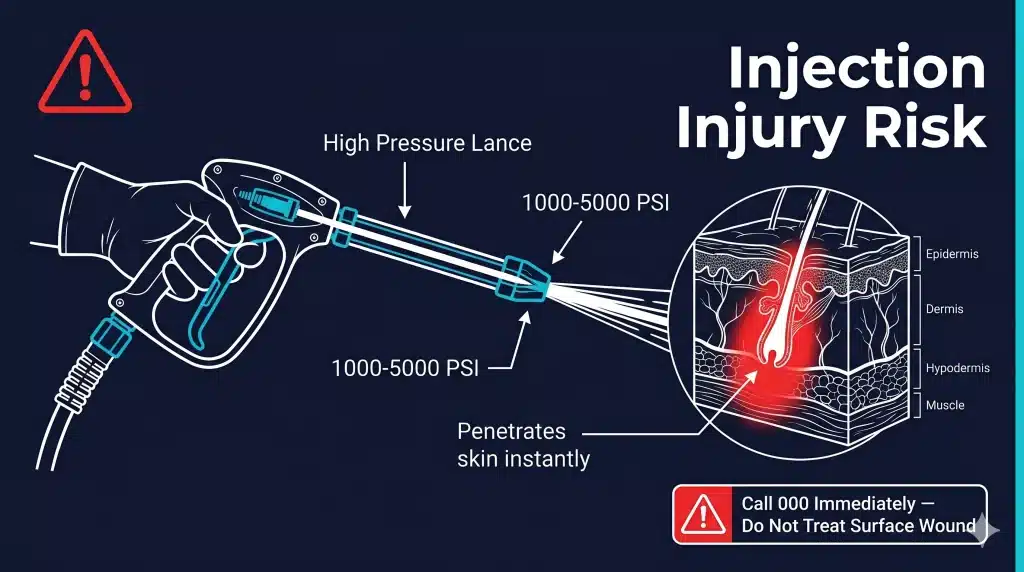
High-pressure water jets generate pressures typically between 1,000 and 5,000 PSI in commercial cleaning applications. At these pressures, direct contact with skin does not feel like a water jet — it feels like nothing at first. The water, cleaning chemical, or contaminated material penetrates beneath the skin surface before the pain response registers. By the time the operator notices, the injury has already occurred.
Why injection injuries are life-threatening:
The injected material — whether clean water, chemical solution, or surface contaminants — creates a pathway for infection deep in the tissue. Without immediate surgical intervention, injection injuries routinely result in amputation of the affected limb. The external wound is typically small and deceptively minor-looking. Emergency department staff without experience in high-pressure injection injuries have been documented treating the surface wound and discharging patients who subsequently lost the limb to infection.
What your Pressure Washing SWMS must include on injection injury:
- A specific injection injury hazard entry — not a generic “equipment hazard” reference
- Trigger safety requirements — the lance must have a trigger lock that prevents accidental discharge when not in use
- Never direct the lance at any person under any circumstances — documented as a specific prohibition
- Minimum 500mm nozzle-to-surface distance maintained at all times
- Two-hand grip required when operating the lance
- Emergency response for injection injury: call 000 immediately, do not attempt to clean or treat the wound, inform emergency services it is a high-pressure injection injury — this last point is critical because the treatment pathway is different from a standard laceration
Most generic SWMS templates mention injection injury in a single line under PPE requirements. A compliant document covers the hazard, the mechanism of injury, the specific controls, and the correct emergency response in detail. That detail is what protects your operator and what satisfies an inspector who understands the equipment.
AS/NZS 4233 — The Standard Your SWMS Should Reference
AS/NZS 4233 is the Australian and New Zealand Standard for high-pressure water jetting. It covers equipment safety, operating procedures, PPE requirements, and operator competency for high-pressure cleaning operations.
Your Pressure Washing SWMS does not legally need to reference this standard — but doing so demonstrates that your document was written to industry best practice, not assembled from a generic template. Principal contractors and facilities managers who review SWMS documents regularly will recognise the reference and treat your documentation with more credibility as a result.
The key AS/NZS 4233 requirements that should appear in your SWMS:
- PPE specification: Waterproof personal protective equipment rated to the operating pressure of the equipment being used. Standard wet weather gear is not sufficient for high-pressure cleaning. Specifically: pressure-rated waterproof trousers and jacket, waterproof steel-capped boots, visor or face shield, chemical-resistant gloves where cleaning chemicals are used
- Operator competency: The standard identifies competency requirements for high-pressure water jetting operators — your SWMS should confirm operator training or competency
- Equipment inspection: Pre-use inspection of hoses, connections, lance, nozzle, and trigger safety before every use
- Pressure rating verification: Confirm the equipment operating pressure does not exceed the rated pressure of the hoses and fittings in use
Including these references makes your document more defensible, more professional, and more likely to pass a principal contractor review on the first submission.
👉 Download CleansePro’s Pressure Washing SWMS — $19.95, instant delivery →
Covers injection injury protocol, AS/NZS 4233 requirements, chemical handling, wastewater disposal and elevated pressure washing controls. Editable Word format, unlimited use.
Chemical Handling in Pressure Washing — What Your SWMS Must Cover
Most commercial pressure washing operations involve cleaning chemicals — degreasers, caustic cleaners, acid-based products for concrete or tile, or surfactants applied through the pressure washer’s chemical injection system. Each introduces hazards that must be specifically addressed in your SWMS.
Chemical identification and SDS
Every chemical used in the pressure washing operation must be identified in the SWMS by product name. The Safety Data Sheet for each product must be physically on site — not just accessible online — before the chemical is opened. Your SWMS must state this explicitly.
Dilution and mixing controls
Concentrated cleaning chemicals used in pressure washing can cause serious chemical burns if handled incorrectly. Your SWMS must specify:
- Correct dilution ratios for each product
- The requirement to add chemical to water — never water to concentrated chemical
- Chemical-resistant gloves and eye protection during mixing
- Prohibition on mixing different chemical products
Chemical injection system controls
Pressure washers with downstream or upstream chemical injection systems present an additional hazard — the chemical is under pressure in the hose system and can be expelled unexpectedly if a fitting fails or the system is vented incorrectly. Your SWMS must cover depressurisation procedures before disconnecting any chemical-carrying hose.
Splash and aerosol controls
High-pressure cleaning generates significant aerosol — fine droplets of water and cleaning chemical that travel well beyond the immediate work area. Where caustic or acidic chemicals are in use, this aerosol presents a respiratory and eye hazard. Your SWMS must specify:
- Face shield or visor — not just safety glasses
- P2 respirator where chemical aerosol cannot be controlled
- Exclusion zone for bystanders during chemical application
Wastewater Disposal — The Liability Most Pressure Washers Don’t Know About
This is the section of a Pressure Washing SWMS that most operators have never thought about — and that could expose your business to environmental prosecution that has nothing to do with worker safety.
High-pressure cleaning generates contaminated wastewater. That wastewater contains the surface contaminants being removed — oil, grease, heavy metals from concrete car parks, biohazardous material from food preparation areas, pesticides from agricultural surfaces — combined with cleaning chemicals. In most Australian states, discharging this wastewater to stormwater drains, kerb and channel, or directly to land is an offence under environmental protection legislation.
What your Pressure Washing SWMS must include on wastewater:
- Identification of the wastewater disposal pathway for this specific job — where will the wastewater go?
- Stormwater drain protection — drain plugs or covers before work starts on any surface adjacent to a stormwater inlet
- Containment method — bunding, squeegee collection, wet vacuum recovery
- Disposal destination — trade waste system via approved connection, or licensed liquid waste contractor for heavily contaminated water
- A specific prohibition on discharge to stormwater, kerb and channel, or land
The real-world consequence of getting this wrong:
A pressure washing contractor who discharges contaminated wastewater — even a relatively small volume — to a stormwater drain can face prosecution under the Environmental Protection Act in Queensland, or equivalent legislation in other states. The fines are significant and the defence of “I didn’t know it wasn’t allowed” is not accepted.
On Gold Coast commercial sites, CleansePro crews carry drain plugs and a wet vacuum as standard equipment on every pressure washing job. The wastewater containment procedure is in every SWMS and it’s the first thing our supervisor checks before the lance is turned on. One job with improper disposal is not worth the risk.
Pressure Washing at Height — Combined Hazards
When pressure washing involves elevated access — cleaning building facades, car park decks above ground level, or roof surfaces — the hazard profile multiplies significantly. The combination of water, recoil force from the lance, and height creates risks that your SWMS must address together, not separately.
Recoil force at height
A high-pressure lance generates significant recoil — particularly at pressures above 3,000 PSI. At ground level, this is manageable with a two-hand grip. On a scaffold platform or in an EWP basket, the same recoil force can destabilise the operator. Your SWMS must specify:
- Maximum operating pressure for elevated work — many principal contractors set a site-specific limit
- Two-hand grip at all times — documented as a non-negotiable control
- Harness anchor point requirements for elevated pressure washing
- Exclusion zone below and beside the work area for water jet misdirection and falling debris
Water and slip hazard on elevated surfaces
Pressure washing on scaffolding or elevated decks creates an immediate slip hazard on the working surface. Water accumulates faster than it drains on most elevated platforms. Your SWMS must cover:
- Non-slip footwear requirements — specifically rated for wet surfaces
- Maximum water accumulation before work pause — a practical trigger point that forces the crew to manage drainage before continuing
- Harness requirements even on fully decked scaffold — water changes the fall risk equation
CleansePro vs SafetyDocs — Pressure Washing SWMS Comparison
| CleansePro | SafetyDocs | |
|---|---|---|
| Pressure Washing SWMS price | $19.95 | $89.95 |
| Injection injury specific controls | Yes | Generic equipment hazard |
| AS/NZS 4233 referenced | Yes | Sometimes |
| Wastewater disposal controls | Yes | Basic reference |
| Chemical injection system controls | Yes | General chemical handling |
| Elevated pressure washing controls | Yes | Generic height reference |
| Written by active cleaning contractors | Yes | Safety document provider |
| Editable Word format | Yes | Yes |
| Unlimited use | Yes | Yes |
| Complete bundle (9 SWMS) | $99 | $89.95 per document |
Frequently Asked Questions
Do I need a SWMS for pressure washing a driveway?
A sole trader pressure washing a residential driveway at ground level with no HRCW conditions present does not legally require a SWMS under the WHS Regulation 2011. However, a safe work procedure is strongly recommended given the injection injury risk, and may be required by your public liability insurer. For any commercial or construction site pressure washing, the SWMS obligation is much more likely to apply — assess the site conditions before assuming you don’t need one.
What PPE is required for pressure washing in Australia?
Under AS/NZS 4233 and general WHS Regulation requirements, pressure washing PPE includes: pressure-rated waterproof trousers and jacket, waterproof steel-capped boots, face shield or visor (not just safety glasses), and chemical-resistant gloves where cleaning chemicals are used. Standard wet weather gear is not rated to the pressures generated by commercial high-pressure cleaning equipment. Your SWMS must specify the PPE by type and standard — not just “wear appropriate PPE.”
Where can I dispose of pressure washing wastewater in Queensland?
In Queensland, contaminated wastewater from pressure washing cannot be discharged to stormwater drains, kerb and channel, or directly to land. Disposal options include: a trade waste connection to the sewer system (requires approval from the local council), collection and removal by a licensed liquid waste contractor, or on-site treatment and infiltration where approved by the relevant authority. Your SWMS must document the disposal pathway for each specific job before work starts.
What pressure is considered high pressure for SWMS purposes?
AS/NZS 4233 classifies high-pressure water jetting as operations above 70 bar (approximately 1,015 PSI). Most commercial pressure washing equipment used in cleaning operations operates above this threshold. If your equipment exceeds 70 bar, the AS/NZS 4233 requirements for PPE, operator competency, and equipment inspection apply — and should be referenced in your SWMS.
Can I use my Window Cleaning SWMS to cover pressure washing on the same job?
No. A Window Cleaning SWMS and a Pressure Washing SWMS cover different tasks with different hazard profiles. Injection injury, wastewater disposal, and chemical injection system controls are specific to pressure washing and will not appear in a window cleaning document. Where a job involves both tasks, carry both documents. CleansePro’s Complete SWMS Bundle includes both at $99 for all nine documents — less than the cost of two individual SafetyDocs templates.
Pressure washing is the task most cleaning contractors underestimate from a compliance perspective. The equipment is common, the work looks straightforward, and the hazards are largely invisible until something goes wrong. An injection injury at 3,000 PSI is a life-changing event for the operator involved. A wastewater discharge to a stormwater drain is an environmental prosecution the business owner didn’t see coming. A compliant, task-specific Pressure Washing SWMS addresses both before the lance turns on.
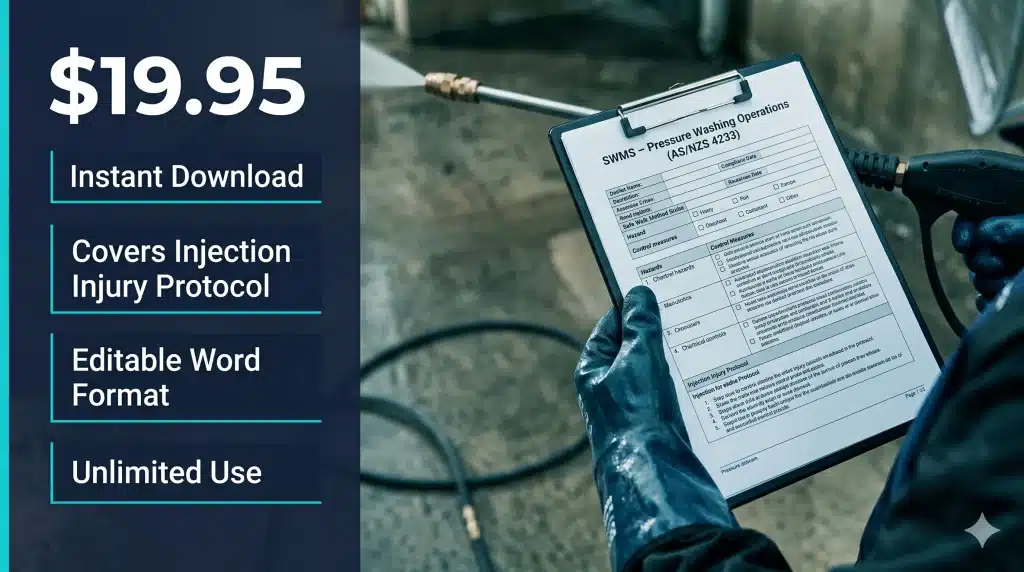
👉 Download CleansePro’s Pressure Washing SWMS — $19.95, instant delivery →
Covers injection injury protocol, AS/NZS 4233, chemical handling, wastewater disposal and elevated pressure washing controls. Editable Word format, unlimited use across your business.
Also read: EWP SWMS Australia — What It Must Cover → Window Cleaning SWMS Australia — Requirements Guide → Do I Need a SWMS for Cleaning? →
Written by CleansePro Team · Last updated April 2026