Window Cleaning SWMS Australia — When You Need One and What It Must Cover
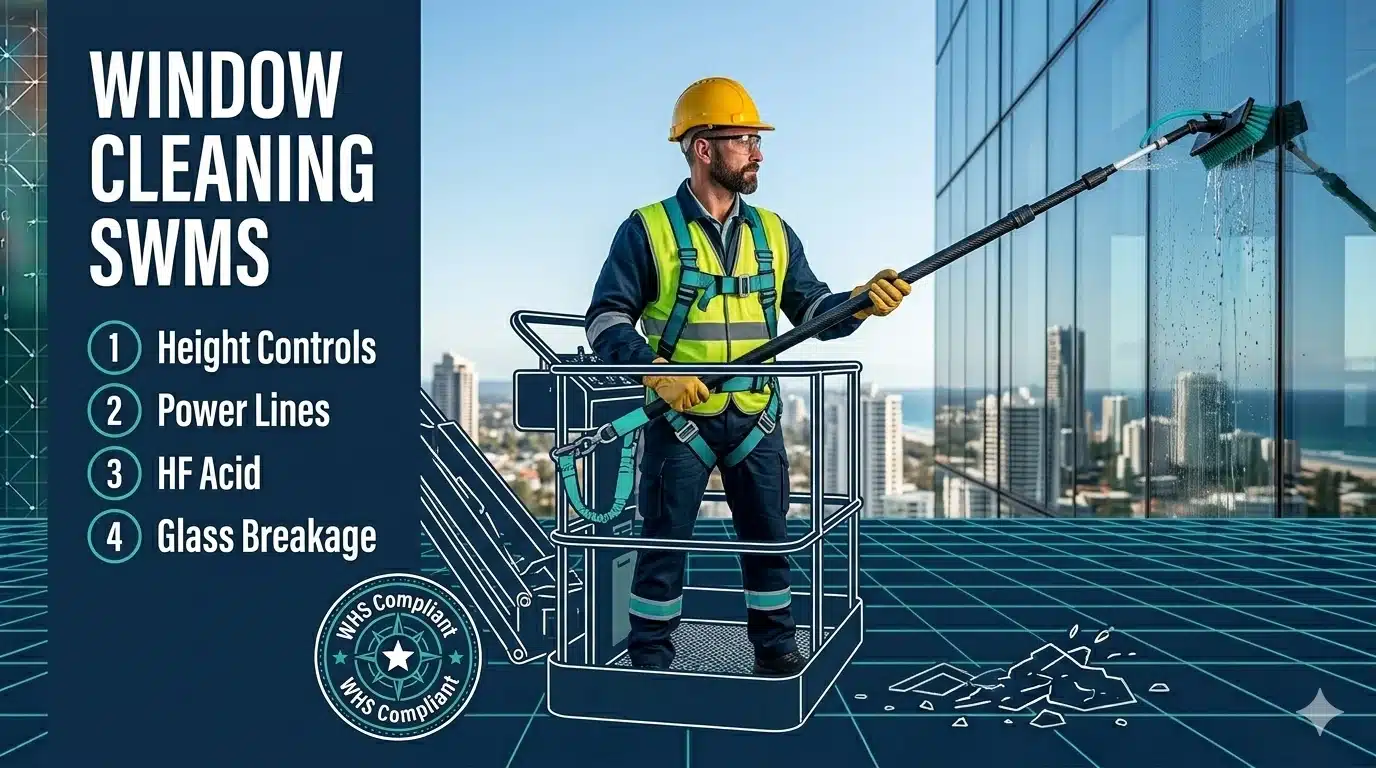
Window cleaning looks straightforward from the ground. From a compliance perspective it is one of the more hazardous cleaning tasks Australian contractors take on — working at height, chemical exposure, powered equipment, live overhead services, and glass breakage risks all in one job. If any part of your window cleaning work involves height above 2 metres, an EWP, or rope access, a Safe Work Method Statement is legally required before work starts.
This guide covers exactly when a Window Cleaning SWMS is required, what Australian law demands inside it, the specific hazards most templates miss entirely, and how CleansePro’s window cleaning crews manage compliance on Gold Coast commercial sites every day.
When Is a Window Cleaning SWMS Legally Required?
The trigger is High-Risk Construction Work under the Work Health and Safety Regulation 2011. For window cleaning contractors, three HRCW categories apply most frequently.
Working at heights above 2 metres
Any window cleaning task where your crew works at a position more than 2 metres above the ground or a floor level. This includes EWP operation beside a building facade, rope access on a multi-storey exterior, and ladder work above the threshold on a construction site. In South Australia the threshold is 3 metres — confirm your state regulator’s requirements if you operate across borders.
EWP operation
Operating a boom lift, scissor lift, or spider lift to access windows at height is itself a separate HRCW trigger — independent of the height threshold. Your EWP SWMS and your Window Cleaning SWMS should be carried together on jobs that involve both. For a detailed breakdown of EWP-specific requirements, read our EWP SWMS guide.
Rope access
IRATA-certified rope access window cleaning at any height on a building facade triggers HRCW. The rope access controls — dual rope systems, anchor point certification, mandatory two-person teams — go beyond standard working at heights controls and require their own documented procedures in your SWMS.
What about water-fed pole window cleaning at ground level?
A water-fed pole system operated from the ground on a residential or low-rise building generally does not trigger HRCW and does not legally require a SWMS. However, if the operator is on a construction site, working near live electrical services, or using the system from an elevated surface — the obligation may still apply. When in doubt, assess the site conditions rather than the equipment being used.
What a Window Cleaning SWMS Must Cover
A compliant document must address every significant hazard your crew will encounter. For window cleaning, that means going beyond generic height controls and documenting the task-specific hazards that inspectors and principal contractors look for.
Working at height controls
The foundation of any Window Cleaning SWMS. Your document must specify:
- The method of elevated access being used — EWP type, rope access system, scaffold, ladder — with the specific equipment model where relevant
- Fall prevention controls for the method being used — edge protection, harness anchor points, exclusion zones below the work area
- Pre-use inspection requirements for all elevated access equipment
- Emergency rescue procedure for a fallen or incapacitated worker at height
Vague statements like “use appropriate fall protection” will not satisfy a WorkSafe inspector or a principal contractor safety officer. Name the equipment, name the controls, name the procedure.
Overhead power line distances
Window cleaning on commercial buildings frequently involves working in proximity to overhead power lines — service connections to the building, street-level lines alongside the facade, or lines running across the work area. Your SWMS must:
- Identify all overhead power lines within the work zone before the job starts
- Document the voltage of each identified line where known
- State the specific exclusion zone distances applicable — 3 metres minimum for lines up to 66 kV in Queensland
- Specify the procedure if a line cannot be identified or voltage cannot be confirmed — treat as the highest voltage category until confirmed otherwise
- Document the emergency response for inadvertent contact — stay in basket, call 000, do not attempt to exit
This is the control that most generic window cleaning SWMS templates either omit entirely or cover with a single generic sentence. On a Gold Coast commercial building with street-level power lines alongside the facade, that omission is a serious compliance gap.
HF acid — the chemical hazard most window cleaners underestimate
Hydrofluoric acid is used in some commercial window cleaning products to remove mineral deposits, construction residue, and hard water staining from glass. It is one of the most hazardous chemicals in any cleaning application — capable of causing deep tissue burns and systemic toxicity through skin absorption, with symptoms that can be delayed for hours after exposure.
If any chemical in your window cleaning kit contains HF or fluoride-based compounds, your SWMS must include:
- Specific HF acid controls — not generic chemical handling controls
- Nitrile or neoprene gloves rated for HF — standard latex gloves provide no protection
- Face shield in addition to safety glasses
- Calcium gluconate gel on site as a first aid measure — this is the specific antidote for HF skin contact and must be available before the chemical is opened
- Emergency response: remove contaminated clothing, apply calcium gluconate gel, call 000 — HF burns require hospital treatment regardless of apparent severity
Most generic window cleaning SWMS documents mention “chemical handling” and “appropriate PPE.” For HF acid that is completely insufficient. If you use these products, your document must be specific.
Glass breakage
Broken glass during window cleaning is a hazard that affects not just the operator but anyone in the exclusion zone below or beside the work area. Your SWMS must cover:
- Ground-level exclusion zone requirements — size of zone, how it is marked, who enforces it
- PPE for glass breakage — cut-resistant gloves for glass handling, appropriate footwear
- Procedure for broken glass disposal
- Communication protocol with site supervisor if a window is broken during the clean
On occupied commercial buildings or sites where pedestrians or other trades are working nearby, the exclusion zone controls are particularly important. A principal contractor who sees a crew cleaning windows above a public footpath without a documented exclusion zone procedure will reject your SWMS immediately.
Water runoff and slip hazard management
Window cleaning generates significant water runoff — particularly with water-fed pole systems and traditional squeegee methods. On multi-storey buildings, runoff from upper floors creates slip hazards for workers and pedestrians on lower levels. Your SWMS must address:
- Runoff containment where practicable
- Wet floor signage at all entry points to the affected area
- Communication with building management or site supervisor about runoff onto occupied areas
- Non-slip footwear requirements for all crew
👉 Download CleansePro’s Window Cleaning SWMS — $19.95, instant delivery →
Covers EWP, rope access, water-fed poles, HF acid controls, power line distances and glass breakage. Editable Word format, unlimited use.
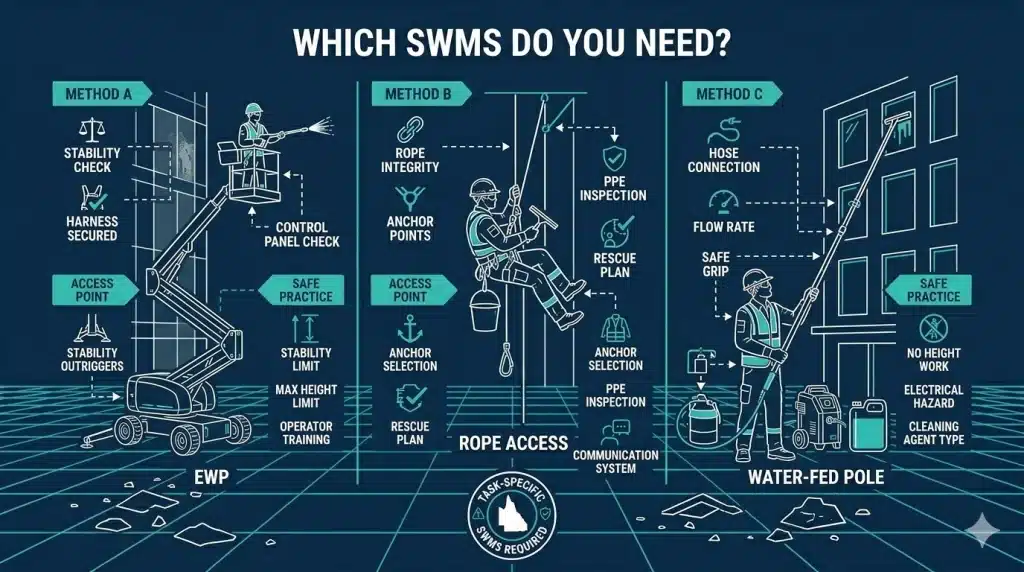
The Three Window Cleaning Methods — How Your SWMS Changes
The specific controls in your SWMS depend on which access method you’re using. A document written for EWP access does not cover rope access. A document written for ladder work does not cover water-fed pole operation from a cherry picker. Your SWMS must match the actual method being used on the specific job.
| Access method | Key SWMS controls | HRWL or competency required |
|---|---|---|
| EWP — boom lift (11m+ boom) | HRWL verification, power line distances, tip-over protocol, emergency lowering, CO controls if indoors | WP class HRWL |
| EWP — scissor lift / boom under 11m | HRWL or EWPA Yellow Card, ground stability, exclusion zone | WS class HRWL or EWPA Yellow Card |
| Rope access — IRATA | Dual rope system, anchor point certification, two-person minimum, rescue plan, suspension trauma protocol | IRATA Level 1 minimum |
| Ladder | Height below 2m unless construction site triggers HRCW, three-point contact, footing | No HRWL — but SWMS if on construction site |
| Water-fed pole from ground | Generally no SWMS required unless site conditions trigger HRCW | No licence requirement |
| Water-fed pole from EWP | EWP controls apply — treat as EWP job | As per EWP class |
If your job combines methods — EWP for upper floors, water-fed pole for lower floors — your SWMS must address both. Don’t write a document for one method and operate both.
What Happens If You Don’t Have a Window Cleaning SWMS
The consequences follow the same pattern as any HRCW without documentation — but window cleaning has some specific exposures worth understanding.
Site access refusal is the most immediate consequence. Commercial building managers, strata managers, and principal contractors increasingly request SWMS documents before scheduling any window cleaning work on their properties. Arriving without one means the job doesn’t start and your crew stands down unpaid.
Insurance implications are significant if an incident occurs during window cleaning without a compliant SWMS. Your public liability insurer will ask whether a SWMS was in place. If it wasn’t, coverage for the incident may be disputed or denied entirely. The document is not just a compliance requirement — it is part of your insurance protection.
WorkSafe investigation following any window cleaning incident — a fall, a chemical exposure, a glass injury — will focus immediately on whether a SWMS existed, whether it was site-specific, and whether workers had signed it before starting. An absent or generic document in the aftermath of a serious incident is an aggravating factor in any prosecution.
At CleansePro, every window cleaning job on a commercial site is preceded by a SWMS review. The cost of that 10-minute process before every job is nothing compared to the cost of a single incident without documentation.
CleansePro vs SafetyDocs — Window Cleaning SWMS Comparison
SafetyDocs is the most well-known SWMS provider in Australia. Their window cleaning SWMS is priced at $89.95. CleansePro’s equivalent is $19.95.
| CleansePro | SafetyDocs | |
|---|---|---|
| Window Cleaning SWMS price | $19.95 | $89.95 |
| HF acid specific controls | Yes | General chemical handling |
| QLD power line distances | Yes | Generic reference |
| EWP and rope access both covered | Yes | Yes |
| Written by active window cleaners | Yes | Safety document provider |
| Editable Word format | Yes | Yes |
| Unlimited use | Yes | Yes |
| Complete bundle (9 SWMS) | $99 | $89.95 per document |
The $70 difference per document adds up quickly across a cleaning business that needs multiple SWMS types. The Complete SWMS Bundle at $99 gives you all nine task-specific documents — including the Window Cleaning SWMS — for less than the price of a single SafetyDocs template.
Frequently Asked Questions
Does residential window cleaning need a SWMS?
Residential window cleaning at ground level or below 2 metres does not legally require a SWMS. If a residential window cleaning job requires ladder work above 2 metres on a construction site, or any form of EWP or rope access, the HRCW obligation applies. For routine residential work where no HRCW conditions are present, a SWMS is not legally required — though a job safety assessment is still good practice.
Do I need a SWMS for water-fed pole window cleaning?
A water-fed pole system operated from the ground generally does not trigger HRCW and does not require a SWMS. If the water-fed pole is being used from an EWP basket, if the operator is working on a construction site, or if site conditions introduce other HRCW triggers, the obligation applies. Assess the site conditions rather than the equipment.
How often should I review my window cleaning SWMS?
Your window cleaning SWMS must be reviewed before every job — the site address, supervisor details, and specific site hazards must be updated to reflect each job. Beyond that, the document should be formally reviewed whenever: the method of access changes, a new chemical is introduced to your kit, an incident occurs during window cleaning work, or WorkSafe publishes updated guidance relevant to your operations. Keep the template current and customise it fresh for each site.
What licence do I need to operate an EWP for window cleaning?
For a boom-type EWP with a boom length of 11 metres or more, a WP class High Risk Work Licence is required. For a boom under 11 metres, a WS class HRWL applies. Scissor lifts on construction sites generally require a WS class HRWL or an EWPA Yellow Card. Your EWP SWMS must document the specific licence class required for the equipment being used and confirm the operator holds a current licence of that class.
Can one SWMS cover both window cleaning and EWP operation?
On a practical level, many cleaning businesses carry two documents together — a Window Cleaning SWMS covering the cleaning task and an EWP SWMS covering the platform operation. This is the cleaner approach because each document addresses a distinct scope and distinct hazard profile. A combined document is acceptable if it specifically addresses all required controls for both scopes — but principal contractors often prefer to see the tasks documented separately.
Window cleaning is one of those tasks that looks simple and carries serious risk. The contractors who win work on commercial buildings and development sites consistently are the ones who show up with documentation that matches the site, the method, and the hazards — not a generic template that was written once and reused without review.
👉 Download CleansePro’s Window Cleaning SWMS — $19.95, instant delivery →
Covers all access methods — EWP, rope access, water-fed pole. HF acid controls, power line distances, glass breakage and runoff management all included. Editable Word format, unlimited use across your business.
Also read: EWP SWMS Australia — What It Must Cover → High-Rise Window Cleaning SWMS — IRATA, Dual Ropes and Suspension Trauma → What Is a SWMS? Plain-English Guide →
Written by CleansePro Team · Last updated April 2026