If you run a cleaning business in Queensland and you’re searching for a SWMS template QLD, you probably already know you need one. What stops most cleaning businesses isn’t the document itself — it’s the uncertainty. When exactly does Queensland law require it? What must be inside it? And will it hold up when a WorkSafe QLD inspector is standing on your site asking for it?
This guide answers all of that. When QLD cleaners are legally required to have a Safe Work Method Statement, what the WHS Regulation 2011 demands inside it, how to complete each section correctly, and where to download a compliant template today — whether that’s a free government version or a pre-filled cleaning-specific document.
When Queensland Cleaners Need a SWMS
A SWMS is not required for every cleaning job. Under the Work Health and Safety Regulation 2011 (Qld), the requirement is triggered specifically by high-risk construction work (HRCW) as defined in Section 291 of the Regulation. The document must be prepared before that work begins — not during it, not after.
For cleaning contractors in Queensland, three HRCW triggers come up most regularly:
- Fall risk above 2 metres — window cleaning from an EWP, roof cleaning, cleaning elevated surfaces on a construction site
- Confined spaces — cleaning inside tanks, plant rooms, enclosed ducts, or storage voids
- Work near energised electrical installations — post-construction cleans where electrical services are live but not yet fully commissioned
If your cleaning task meets any one of these conditions, a compliant SWMS template QLD is legally mandatory — regardless of what you’re actually cleaning. The task doesn’t need to be labelled “construction work.” The working conditions are what trigger the obligation.
Cleaning tasks that cross the HRCW threshold in QLD
High-level window cleaning from a boom lift at 3–4 metres is the clearest example. Roof cleaning where workers access the roof surface. Cleaning inside storage tanks or enclosed plant rooms. Post-construction dust removal in crawl spaces or voids. Any cleaner operating an EWP at 2 metres or above must have a completed, signed SWMS on site before the platform moves — regardless of what they’re cleaning or wiping.
Cleaning tasks that generally don’t require a SWMS
Ground-level commercial cleaning, standard office cleaning, and routine residential cleaning don’t trigger HRCW under the Regulation. That said, some principal contractors require a SWMS as a condition of site access even for lower-risk tasks — because it’s in their WHS management plan, not because Queensland law mandates it for that specific task. Always check the site requirements before arriving.
What the WHS Regulation 2011 Requires Inside Your QLD SWMS
Once you’ve confirmed a SWMS is required, the content must meet specific mandatory requirements. Generic or half-finished documents don’t cut it. Under Sections 291–299 of the WHS Regulation 2011 (Qld), a compliant SWMS must include all of the following.
The mandatory content under Queensland law:
- The specific type of high-risk construction work being performed
- Each task listed in logical, sequential steps
- The health and safety hazards associated with each step
- The control measures selected to manage each hazard — ranked according to the hierarchy of controls (elimination → substitution → engineering → administrative → PPE)
- How those controls will be implemented, monitored, and reviewed during the work
- The document must be written in a format workers can actually read and understand — plain English, diagrams if needed
The recommended details that strengthen compliance:
Under Section 293 of the Regulation, WorkSafe QLD guidance supports including the PCBU’s name, ABN, and address; the responsible supervisor’s name; the principal contractor’s details; preparation and provision dates; and a scheduled review date. These aren’t technically mandatory but they make the document defensible during an audit or after a notifiable incident — and inspectors expect to see them.
The fine for getting it wrong: Fines for a Category 3 breach under the WHS Act — which includes failing to have a compliant SWMS for HRCW — can reach $634,000 for a PCBU (business). Individual workers can also be fined. The immediate on-site consequence is a work stoppage that costs far more than any fine to resolve.
How to Complete Each Section of a QLD SWMS Template
Filling out a blank SWMS template is where most cleaning businesses make errors or waste time. Each section builds on the one before it — what you document as a hazard determines which controls are appropriate.
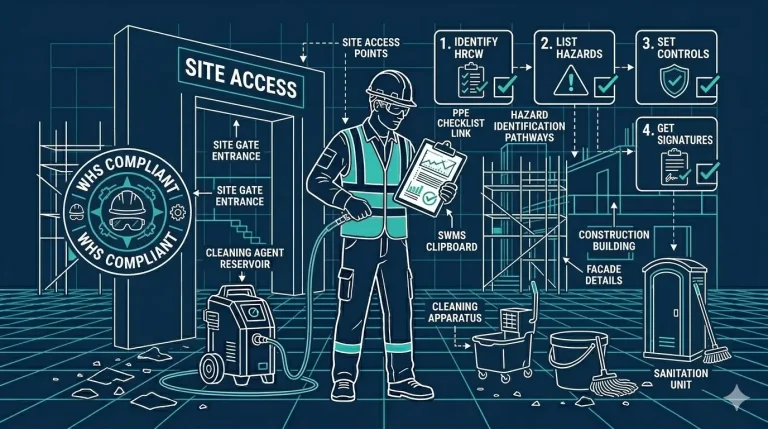
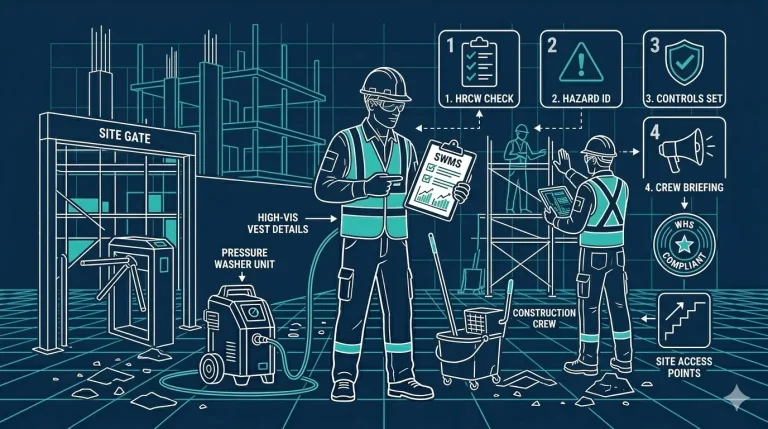
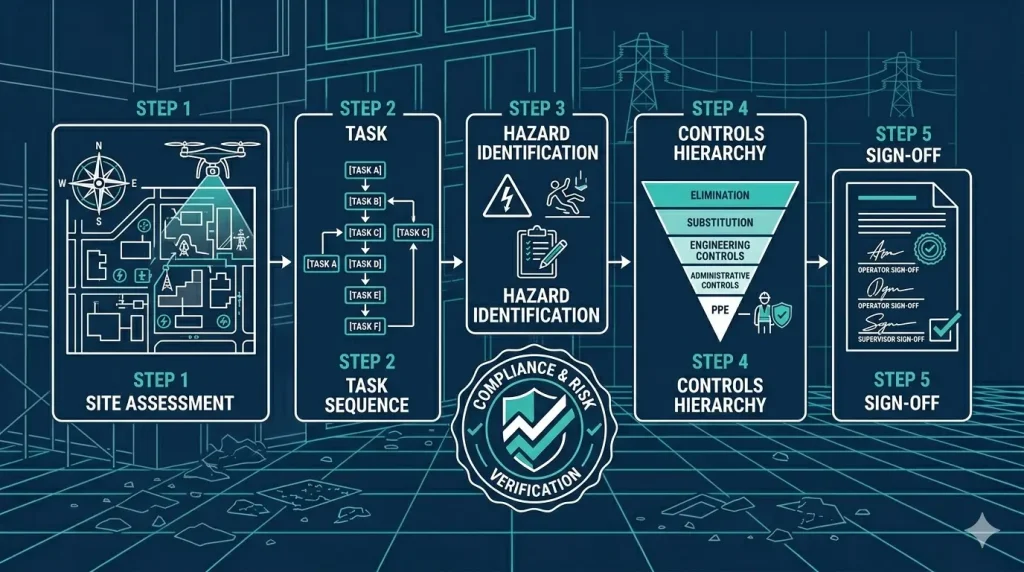
Step 1 — Break the job into a task sequence
Start by breaking the job into 5–12 logical steps from site setup through to pack-down and handover. For a high-level window clean from an EWP, that sequence looks like:
- Site assessment and hazard identification
- Erect or position elevated work platform
- Pre-use EWP inspection
- Cleaning work at height
- Descent and equipment pack-down
- Site handover and sign-off
Each step must reflect actual workflow — not an idealised version of it. Queensland law requires that you consult with the workers carrying out the task during this stage. It’s not a recommendation.
Step 2 — Name the hazard for each step specifically
Vague hazard descriptions fail inspections. “Fall risk” alone is not acceptable. “Unguarded edge at 4 metres during window cleaning from EWP” is. For each task step, name the specific hazard — what it is, where it is, and under what conditions it occurs.
Step 3 — Apply the hierarchy of controls in order
For each hazard, document your control measures starting from the highest practicable level:
- Eliminate the risk where possible
- Substitute with something less hazardous
- Engineer a solution (guardrails, exclusion zones, HEPA filtration)
- Administrative controls (safe work procedures, signage, supervision)
- PPE as the last line of defence — not the first
For cleaning at height, a properly rated EWP is an engineering control and outranks a harness-only approach. If you choose a lower-level control because a higher-level option wasn’t practicable, document the reason in the SWMS. Inspectors expect to see that thought process.
Step 4 — Review, monitoring, and signatures
The SWMS must include how and when controls will be monitored during the work. Daily pre-start checks, toolbox talks, and a stop-work protocol if site conditions change are standard inclusions.
Every worker assigned to the task must sign the document to confirm they have read, understood, and agreed to follow it before work starts. The principal contractor also signs off before the job begins. Dates on every signature are non-negotiable for an inspection-ready document. A SWMS without worker signatures is an incomplete one.
👉 Browse CleansePro’s task-specific SWMS templates — from $19.95, instant download →
Pre-filled for Queensland cleaning tasks. Editable Word format. Ready to customise for your site in under 10 minutes.
Where to Get a Compliant SWMS Template QLD
You have two options: free government templates, or pre-filled task-specific templates built for cleaning work. Both are valid starting points — the difference is how much work you need to do before the document is site-ready.
Free official Queensland government templates
Resources Safety and Health Queensland (RSHQ) and the Queensland Department of Education both publish free, editable SWMS templates in Word format that meet local WHS Regulation 2011 requirements. Search the WorkSafe Queensland website directly for the current version — templates are updated periodically and older versions may not reflect the most recent regulatory changes.
Use the QLD government template to ensure the format meets jurisdiction-specific requirements. If you operate across state lines — particularly across QLD and NSW — maintain familiarity with both states’ templates, as requirements differ at the margin.
Pre-filled SWMS templates built for cleaning tasks
Blank government templates still require significant customisation, and this is where cleaning businesses most commonly make compliance errors. A template written for a civil construction contractor won’t map naturally onto a high-level window clean, a post-construction builder clean, or a confined-space plant room job.
CleansePro’s SWMS templates are pre-filled for the specific hazards, control measures, and task sequences that cleaning contractors encounter — including QLD-specific compliance requirements. They’re editable in Microsoft Word, cover unlimited use across your business, and are available from $19.95 each.
| Task | Template | Price |
|---|---|---|
| Final builders clean (post-construction) | Final Builders Clean SWMS | $19.95 |
| Window cleaning (EWP, rope access, water-fed pole) | Window Cleaning SWMS | $19.95 |
| EWP operation (boom lift, scissor lift) | EWP SWMS | $19.95 |
| Pressure washing | Pressure Washing SWMS | $19.95 |
| Carpet cleaning | Carpet Cleaning SWMS | $19.95 |
| General commercial cleaning | General Cleaning SWMS | $19.95 |
| All 9 tasks in one package | Complete SWMS Bundle | $99.00 |
Storing Your Completed SWMS and Staying Inspection-Ready
Completing and signing the SWMS is only part of your legal obligation. Queensland law sets clear rules on how long the document must be kept and where it must be accessible.
How long must you keep a SWMS in QLD?
The SWMS must be kept for the duration of the high-risk construction work. If a notifiable incident occurs that is related to the work covered by the document, it must be retained for at least two years from the date of the incident. All revised versions must be kept — not just the most recent one.
On-site access requirements:
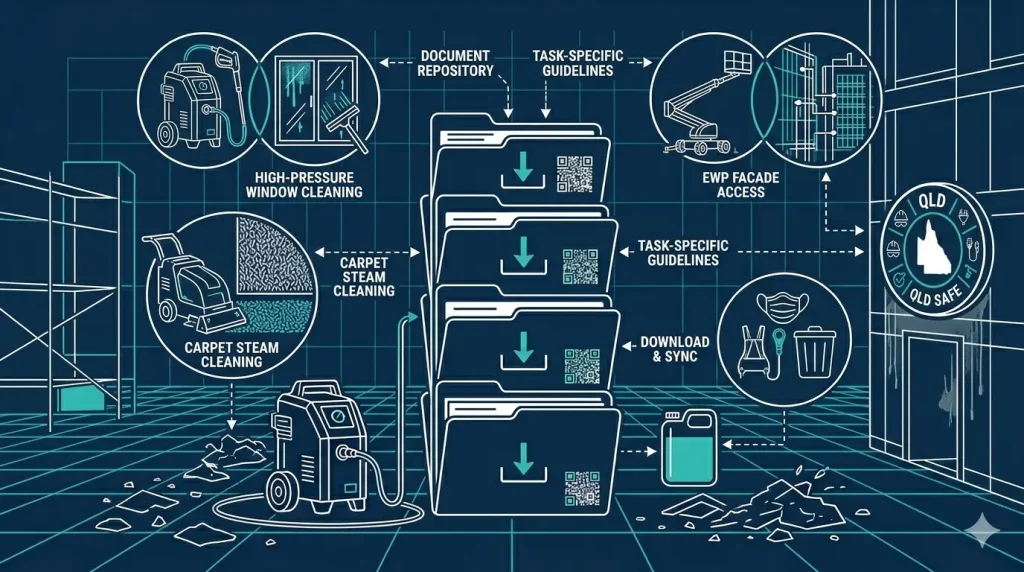
The document must be accessible to any worker carrying out the work and available for inspection by a WorkSafe QLD inspector at any time during the project. Keeping it in a folder back at the office while your crew is on site does not meet the accessibility requirement. Digital copies on a tablet or phone are a practical solution — confirm with your state regulator that your format is acceptable.
When site conditions change:
If conditions change during the job, the SWMS must be reviewed, revised, and re-briefed to all workers before work continues. A new worker briefing and fresh signatures are required — updating the document alone is not sufficient. The SWMS is a living document, not a one-time checkbox.
A Pre-Submission Checklist for QLD Cleaners
Before submitting your completed SWMS to a principal contractor, run through this checklist. Five minutes now prevents a site shutdown that costs far more to resolve.
- The HRCW type is clearly identified and matches the actual work being performed
- Each work step is listed in sequential order with no gaps in the task flow
- Hazards are named for each individual step — not just for the job as a whole
- Control measures follow the hierarchy of controls and are specific enough to be actionable
- The PCBU’s name, ABN, and the work address are complete
- All responsible persons are named with their roles clear
- Every worker assigned to the task has signed before work starts
- Review date is set if site conditions are expected to change
- A copy is accessible on-site throughout the job
Building this checklist into your standard pre-job workflow removes the risk of missing something under time pressure on the morning of a job.
Frequently Asked Questions
How much can a Queensland cleaning business be fined for not having a SWMS?
Under the WHS Regulation 2011 (Qld), fines for a Category 3 breach — which includes failing to have a compliant SWMS for high-risk construction work — can reach $634,000 for a PCBU (business). Individual workers can also receive personal fines. The immediate on-site consequence is a work stoppage until a compliant document is produced. That downtime typically costs more than the fine itself.
Do I need a new SWMS for every job in Queensland?
You can use the same SWMS template across multiple jobs, but it must be reviewed and updated for each specific site before work starts. The work address, site supervisor name, site-specific hazards, and emergency contact details must reflect the actual job. A template that has not been customised for the specific site is non-compliant under the WHS Regulation 2011 (Qld).
How long must a SWMS be kept after the job is finished in QLD?
The SWMS must be kept for the duration of the high-risk construction work. If a notifiable incident occurs related to the work, the document must be retained for a minimum of two years from the incident date. All revised versions of the document must be kept — not only the most recent.
Can I use a SWMS template from another state for Queensland work?
A template from another state can be a starting point, but it must be customised to meet Queensland’s WHS Regulation 2011 requirements — including Section 291 HRCW triggers and the mandatory content under Sections 291–299. A document referencing another state’s legislation, or not reflecting QLD-specific requirements, may fail a WorkSafe Queensland inspection.
Does a sole trader cleaning contractor in QLD need a SWMS?
Yes — if the work involves HRCW as defined under Section 291 of the WHS Regulation 2011 (Qld). Being a sole trader does not exempt you from the PCBU obligations under the Act. Most principal contractors also require a SWMS from every trade on site as a contractual condition of access, regardless of business structure.
A SWMS template QLD that holds up to inspection is specific to the task, correctly completed in every section, accessible on-site, and retained for the required period. Understanding when one is legally required protects your workers. Understanding what goes inside it protects your business from fines, prohibition notices, and work stoppages that cost far more than doing it properly from the start.
👉 Download a task-specific cleaning SWMS — from $19.95, instant delivery →
Or browse individual templates: Final Builders Clean SWMS · Window Cleaning SWMS · Complete SWMS Bundle — all 9 for $99
Written by CleansePro Team · Last updated April 2026
Also read: Final Builders Clean SWMS — What It Must Include →
{ “@context”: “https://schema.org”, “@type”: “Article”, “headline”: “SWMS Template QLD — A Complete Guide for Queensland Cleaners (2026)”, “description”: “When Queensland cleaners need a SWMS, what the WHS Regulation 2011 requires inside it, how to complete each section, and where to download a compliant template. Covers fines up to $634,000 and retention requirements.”, “author”: { “@type”: “Organization”, “name”: “CleansePro”, “url”: “https://cleansepro.com.au” }, “publisher”: { “@type”: “Organization”, “name”: “CleansePro”, “url”: “https://cleansepro.com.au” }, “mainEntityOfPage”: “https://cleansepro.com.au/best-cleaning-blog/swms-template-qld/”, “datePublished”: “2026-04-05”, “dateModified”: “2026-04-08”, “keywords”: “swms template qld, queensland swms template, worksafe qld swms cleaning, cleaning swms qld” } { “@context”: “https://schema.org”, “@type”: “FAQPage”, “mainEntity”: [ { “@type”: “Question”, “name”: “How much can a Queensland cleaning business be fined for not having a SWMS?”, “acceptedAnswer”: { “@type”: “Answer”, “text”: “Under the WHS Regulation 2011 (Qld), fines for a Category 3 breach — including failing to have a compliant SWMS for high-risk construction work — can reach $634,000 for a PCBU (business). Individual workers can also receive personal fines. The immediate on-site consequence is a work stoppage until a compliant document is produced.” } }, { “@type”: “Question”, “name”: “Do I need a new SWMS for every job in Queensland?”, “acceptedAnswer”: { “@type”: “Answer”, “text”: “You can use the same SWMS template across multiple jobs, but it must be reviewed and updated for each specific site before work starts. The work address, site supervisor name, site-specific hazards, and emergency contacts must reflect the actual job. A template not customised for the specific site is non-compliant under the WHS Regulation 2011 (Qld).” } }, { “@type”: “Question”, “name”: “How long must a SWMS be kept after the job is finished in QLD?”, “acceptedAnswer”: { “@type”: “Answer”, “text”: “The SWMS must be kept for the duration of the high-risk construction work. If a notifiable incident occurs related to the work, the document must be retained for a minimum of two years from the incident date. All revised versions must be kept, not only the most recent.” } }, { “@type”: “Question”, “name”: “Can I use a SWMS template from another state for Queensland work?”, “acceptedAnswer”: { “@type”: “Answer”, “text”: “A template from another state can be a starting point but must be customised to meet Queensland’s WHS Regulation 2011 requirements, including Section 291 HRCW triggers and mandatory content under Sections 291-299. A document referencing another state’s legislation may fail a WorkSafe Queensland inspection.” } }, { “@type”: “Question”, “name”: “Does a sole trader cleaning contractor in QLD need a SWMS?”, “acceptedAnswer”: { “@type”: “Answer”, “text”: “Yes — if the work involves high-risk construction work as defined under Section 291 of the WHS Regulation 2011 (Qld). Being a sole trader does not exempt you from PCBU obligations under the Act. Most principal contractors also require a SWMS from every trade on site regardless of business structure.” } } ] }